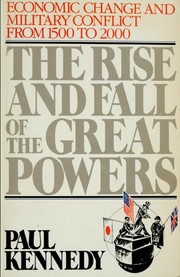
The Rise and Fall of the Great Powers
Military spending measured against the economy that has to carry it.
Summary
Kennedy examines the great powers from 1500 to the late twentieth century and argues that a power's international position is determined by its relative economic position, and that powers decline when their military and strategic commitments exceed what their economic base can support. He calls this imperial overstretch.
The historical work covers Habsburg Spain, the Netherlands, France, Britain, Germany, Russia, Japan and the United States, with detailed attention to the economics of war finance, industrial production, population and relative shares of world manufacturing output. He assembles comparative economic data across five centuries and shows the pattern repeating: a power's rise rests on economic growth, that growth funds military expansion and commitments, the commitments become permanent while the relative economic position erodes as other powers grow faster, and the resulting gap is closed either by retrenchment or by defeat.
The final chapter applied the argument to the United States in the 1980s and predicted relative decline, which is what made the book famous and what has been most criticised. The Soviet Union collapsed instead, and American relative economic position improved through the 1990s. Kennedy's defenders point out that he argued about relative shares over long periods rather than making a short-term prediction, and that the underlying data on American share of world output has in fact declined as he described. The book remains the standard reference on the relationship between economic base and strategic commitment, and its comparative data is its most durable contribution.
Key takeaways 7
- A great power's international position is determined by its relative rather than absolute economic strength, so a growing power can decline if others grow faster.
- Powers decline when strategic and military commitments exceed what the economic base can sustain, and commitments are far harder to reduce than to acquire.
- Military spending diverts capital and skilled labour from productive investment, which accelerates the erosion of the economic base that funds it.
- The pattern of overextension repeats across Habsburg Spain, Bourbon France, Britain and the Soviet Union with the same mechanism in each case.
- Wars between great powers are decided by productive capacity and financial staying power more than by initial military advantage.
- Relative shares of world manufacturing output are the best available leading indicator of shifts in international position.
- A declining power's most difficult problem is political rather than economic, because reducing commitments requires admitting a change in status.
Who should read it
Macro investors and strategists who want the standard analysis of how economic base and strategic commitment interact over long periods.
Where it sits in the reference 2
Who recommended it 2 · 1 direct
Similar books 6
Chosen by shared topics, the entries that hold them, and the people who recommended both.