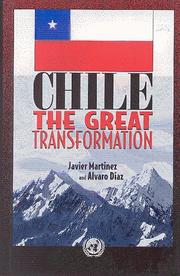
Chile: The Great Transformation
How the productive structure and business class were remade after 1973.
Summary
The reference has not verified this book in detail; the summary states only what the title, author and subject establish.
Martinez and Diaz, Chilean sociologists, wrote an analysis of the transformation Chile underwent between 1973 and the early 1990s, covering the economic restructuring and its social consequences.
The reference has not verified the book's detailed contents. The subject is the transition from the industrialising, state-directed, unionised economy that Chile had built through import substitution up to 1973, to the open, export-oriented, deregulated economy that emerged under the military government and continued under the democratic governments after 1990.
The analytical questions such a study addresses include the destruction of the industrial sector during the initial liberalisation and the 1982 crisis; the reorientation toward natural resource exports including copper, fruit, forestry, fish and wine; the destruction of the labour movement, both through direct repression and through the labour code that fragmented bargaining; the changed class structure that resulted, with the decline of the industrial working class and the growth of informal and service employment; the emergence of new business groups; and the question of what the democratic transition after 1990 changed and what it left in place.
Martinez and Diaz write from a sociological perspective concerned with class structure and with the political consequences of economic change, and the book was published as the democratic governments were continuing rather than reversing the economic model.
Readers should verify the book's specific arguments. The subsequent decades, including the substantial poverty reduction of the 1990s and 2000s and the political reaction of 2019 onward, are outside it.
Key takeaways 7
- Chile shifted from an industrialising state-directed economy to an open resource-export economy between 1973 and the early 1990s.
- The initial liberalisation and the 1982 crisis destroyed much of the industrial sector built under import substitution.
- The economy reoriented toward natural resource exports including copper, fruit, forestry and fish.
- The labour movement was destroyed through both direct repression and a labour code that fragmented collective bargaining.
- The industrial working class declined while informal and service employment grew, which changed the country's class structure.
- Democratic governments after 1990 continued rather than reversed the economic model they inherited.
- New business groups emerged from the privatisations and became the country's dominant economic actors.
Who should read it
Analysts studying Chile's structural transformation and its social consequences, verified against the book's actual arguments.
Where it sits in the reference 2
Similar books 6
Chosen by shared topics, the entries that hold them, and the people who recommended both.