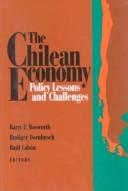
The Chilean Economy: Policy Lessons and Challenges
Brookings assessment of the reform package by economists who took it seriously.
Summary
Barry Bosworth, Rudiger Dornbusch and Raul Laban edited this Brookings volume assessing Chilean economic policy at the point when the country had returned to democracy and had become the standard reference case for market reform in Latin America.
The chapters cover the major policy areas. Macroeconomic management and the central bank's independence and its use of capital controls on short-term inflows, which became a widely discussed instrument. Trade liberalisation and export diversification beyond copper. The privatised pension system introduced in 1981 and its effects on savings, capital markets and coverage. Financial sector regulation following the 1982 banking crisis, which had required a large state rescue and which produced Chile's subsequently strict supervision. Labour markets, poverty and income distribution, where the record was substantially worse than the growth record.
The volume is empirical and the contributors do not agree with each other on all points. Its assessment is that Chile's growth resulted from sustained policy across governments rather than from any single reform, that the 1982 crisis taught lessons that the country applied and its neighbours did not, and that the distributional record remained poor. It was published in 1994, so the subsequent copper boom, the pension system's coverage problems and the political reaction of the 2010s and 2020s fall outside it.
Key takeaways 7
- Chile's growth came from sustained policy continuity across governments rather than from the initial reforms alone.
- The 1982 banking crisis required a large state rescue and produced the strict financial supervision that later protected the country.
- Capital controls on short-term inflows were used as a macroeconomic instrument and are assessed here with mixed conclusions.
- The privatised pension system raised national savings and developed capital markets while leaving coverage gaps.
- Export diversification beyond copper was a deliberate policy achievement rather than an automatic consequence of liberalisation.
- Chile's distributional record remained poor despite its growth record, which the contributors treat as a policy failure rather than an inevitability.
- The contributors disagree with each other, which makes the volume more useful than a single-author assessment.
Who should read it
Analysts of Latin American reform who want an empirical multi-author assessment of the region's most-cited policy case.
Where it sits in the reference 2
Similar books 6
Chosen by shared topics, the entries that hold them, and the people who recommended both.