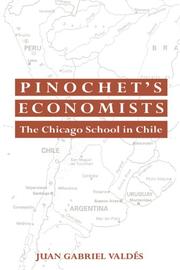
Pinochet's Economists: The Chicago School in Chile
How an economics faculty exchange programme became a national policy regime.
Summary
Juan Gabriel Valdes, a Chilean political scientist who later served as his country's foreign minister, traces how a group of Chilean economists trained at the University of Chicago came to direct economic policy under the Pinochet dictatorship.
The institutional history is the book's contribution. Valdes documents the Chile Project, an agreement signed in 1955 between the University of Chicago and the Catholic University of Chile, funded by the United States government's international cooperation programme and later by the Ford Foundation, under which Chilean students were trained at Chicago and Chicago faculty taught in Santiago. He shows that the explicit purpose was to counter the structuralist economics dominant in Latin America and associated with the United Nations regional commission in Santiago. Over two decades the programme produced a cohort with a shared doctrine and shared networks.
Valdes then traces how this cohort, marginal in Chilean policy debate through the 1960s, prepared a programme document before the 1973 coup and was installed in government from 1975. He is interested in the transfer of ideology rather than in evaluating the policies, and he argues that the doctrine's appeal to the military lay partly in its claim to technical objectivity, which removed economic questions from political contest. The book is critical and readers should note the author's political position. Its documentation of the training programme and its funding is the part that has entered the standard record.
Key takeaways 7
- The Chicago training of Chilean economists was a deliberate American-funded programme intended to counter structuralist economics in Latin America.
- The programme created a cohort with shared doctrine and shared networks, which is what made rapid policy capture possible after 1973.
- The Chicago group prepared a detailed policy programme before the coup and had it ready when the military needed one.
- Economic doctrine presented as technical rather than political appealed to a military government that wanted decisions removed from contest.
- Valdes argues that ideological transfer through professional training is more durable than transfer through advice or conditionality.
- The group's marginal position in Chilean debate before 1973 shows that the coup, not persuasion, gave them authority.
- Technocratic authority insulated from political accountability permitted policy changes no democratic government could have imposed.
Who should read it
Readers examining how economic doctrines transfer between countries and how technocratic authority is constructed, using the best-documented case.
Where it sits in the reference 2
Similar books 6
Chosen by shared topics, the entries that hold them, and the people who recommended both.