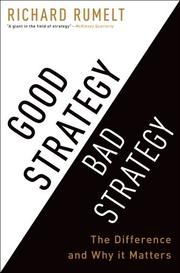
Good Strategy Bad Strategy
Open Library unreachable this run; title not machine-verified.
Summary
Rumelt argues that most documents called strategy are not strategy, and gives a specific definition to replace the vagueness. A good strategy has what he calls a kernel with three parts: a diagnosis that identifies the critical challenge and simplifies an overwhelming situation into a manageable one, a guiding policy that specifies an overall approach to that challenge, and coherent actions that are coordinated and that actually follow from the policy.
His account of bad strategy is the more useful half. He identifies four hallmarks: fluff, meaning language that restates the obvious in inflated terms; failure to face the challenge, in which a document sets goals without identifying the obstacle; mistaking goals for strategy, where a list of targets substitutes for a method of achieving them; and bad strategic objectives, meaning objectives that fail to address critical issues or that are impracticable.
He argues that strategy requires choosing what not to do and accepting that some parts of the organisation will lose resources, and that this is why organisations avoid it. He also argues that strategy works through leverage, meaning the concentration of effort on a pivot point where it will produce disproportionate effect.
The cases include Wal-Mart's store network as a system rather than as individual stores, Nvidia's chip release cadence, the 1991 Gulf War ground plan, Apple's 1997 product line cut, and several failures. Rumelt's evidence is case-based and chosen after outcomes. The definition of a critical challenge cannot be operationalised in advance. The book's value is diagnostic rather than generative: it will not tell a reader what their strategy should be, and it will tell them quickly whether what they have is one.
Key takeaways 8
- A strategy consists of a diagnosis of the critical challenge, a guiding policy for addressing it, and coherent actions that follow from that policy.
- Most documents called strategy are lists of goals and financial targets, which state desired outcomes without specifying any method.
- Bad strategy is identifiable by inflated language, failure to name the actual obstacle, and objectives that do not address the critical issue.
- A diagnosis is valuable when it simplifies an overwhelming situation by identifying which parts matter, which necessarily means discarding others.
- Strategy requires deciding what not to do, and organisations avoid it because the decision imposes visible losses on internal groups.
- Coordinated actions produce advantage because coordination itself is costly and competitors will not undertake it.
- Leverage means concentrating effort at a point where the situation will amplify it, which requires identifying the pivot rather than distributing effort evenly.
- Setting an ambitious goal is not strategy, and calling it one prevents the organisation from noticing that no method has been proposed.
Who should read it
Executives who need to test whether their strategy document contains a strategy, and founders whose plans are lists of targets.
About Richard Rumelt
Harry and Elsa Kunin Professor Emeritus of Business and Society, UCLA Anderson School of Management; previously INSEAD and Harvard Business School
Good Strategy Bad Strategy is the standard reference for what a strategy actually is, and his 1974 diversification study founded an empirical literature.
Where it sits in the reference 5
Who recommended it 4
Similar books 6
Chosen by shared topics, the entries that hold them, and the people who recommended both.