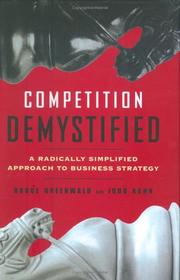
Competition Demystified: A Radically Simplified Approach to Business Strategy
Barriers to entry as the only durable source of a toll.
Summary
Greenwald and Kahn argue that Porter's five forces framework is too complicated for practical use, and that only one force matters: barriers to entry. Their claim is that if a company is earning high returns and competitors can enter, the returns disappear, so every other consideration is secondary to whether entry is prevented.
They identify exactly three sources of genuine barriers. Demand advantages come from customer captivity through habit, switching costs or search costs. Supply advantages come from proprietary technology or from cost positions competitors cannot match. Economies of scale, which they treat as the most important, work only when combined with customer captivity, since scale without captivity invites competitors to build the same scale.
Their practical test is empirical rather than theoretical. Stable market shares over long periods indicate a barrier, because volatile shares mean entry and exit are occurring. Sustained high returns on capital indicate a barrier, because competition would otherwise have removed them. They argue that these two observations settle the question faster than any qualitative analysis.
They also argue that competitive advantages are almost always local rather than global, meaning geographically or in a defined product niche, and that companies destroy value by expanding beyond the area where the barrier operates. Their treatment of Walmart's regional strength and Coors' failed national expansion makes the point. The framework is deliberately narrow and gives no guidance where no barrier exists, which they treat as the ordinary case requiring operational efficiency rather than strategy. The stable share and high return tests are the most usable diagnostic in the strategy literature.
Key takeaways 8
- Barriers to entry are the only competitive force that matters, since without them high returns attract entry and disappear.
- There are exactly three sources of genuine barriers, which are customer captivity, cost advantages and economies of scale combined with captivity.
- Economies of scale without customer captivity provide no protection, because a competitor can build the same scale.
- Stable market shares over long periods indicate a barrier, while volatile shares indicate that entry and exit are occurring freely.
- Sustained high returns on invested capital indicate a barrier, because competition would otherwise have competed them away.
- Competitive advantages are almost always local, meaning geographic or within a defined niche, rather than global.
- Expanding beyond the area where the barrier operates destroys value, which is the standard error made by companies with genuine local advantages.
- Where no barrier exists, the only available response is operational efficiency, and calling that strategy misdescribes it.
Who should read it
Investors and executives who want a narrow practical test for whether a competitive advantage exists rather than a comprehensive analytical framework.
About Bruce Greenwald
Robert Heilbrunn Professor Emeritus of Finance and Asset Management, Columbia Business School; former director of the Heilbrunn Center for Graham and Dodd Investing
Value Investing: From Graham to Buffett and Beyond is the canonical modern restatement of the Columbia value framework, and Competition Demystified is its standard companion on barriers to entry.
Where it sits in the reference 6
Who recommended it 2 · 1 direct
Similar books 6
Chosen by shared topics, the entries that hold them, and the people who recommended both.