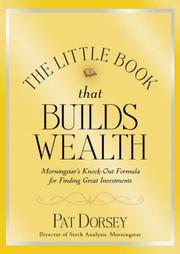
The Little Book That Builds Wealth
Morningstar's moat taxonomy in its shortest form.
Summary
Dorsey ran equity research at Morningstar and built the framework the firm uses to rate economic moats. The book explains what a durable competitive advantage is, what it is not, and how to identify one from public information.
He identifies four genuine sources. Intangible assets include brands that permit a price premium, patents with remaining life and defensible claims, and regulatory licences that restrict entry. Switching costs make it expensive or disruptive for a customer to move to a competitor, which he treats as the most underrated source. The network effect makes a service more valuable as more people use it, which he identifies as the most powerful and the rarest. Cost advantages come from process, location, scale or unique assets, and he distinguishes those that persist from those competitors can replicate.
His list of false moats is equally useful. Great products, high market share, operational efficiency and good management are all things he argues can be copied or lost, and none of them constitutes a moat despite being what most investors point to. His practical test is return on invested capital sustained above the cost of capital over long periods, which is the observable consequence of a moat, combined with an identification of which of the four sources produces it.
The book is short and written for non-professionals. The examples are from before 2008 and several companies described as having moats have since lost them. The four categories and the false moat list are the framework Morningstar still uses and remain the most compact statement of the subject.
Key takeaways 8
- A moat is a structural characteristic that allows sustained returns above the cost of capital, and there are only four sources of one.
- Intangible assets including brands, patents and regulatory licences create a moat only where they permit a price premium or restrict entry.
- Switching costs are the most underrated source, since a customer who would find changing expensive or disruptive will tolerate worse terms.
- Network effects are the most powerful and the rarest source, and they produce winner-take-most outcomes where they exist.
- Cost advantages persist only where they come from process, location, scale or unique assets that competitors cannot replicate.
- Great products, high market share, operational efficiency and good management are not moats, because all four can be copied or lost.
- Sustained return on invested capital above the cost of capital is the observable evidence that a moat exists.
- A moat must be attributed to a specific source, and an investor who cannot name which of the four applies has not identified one.
Who should read it
Investors who want a compact and practical framework for identifying durable competitive advantage from public financial information.
About Pat Dorsey
Founder and Chief Investment Officer, Dorsey Asset Management; formerly Director of Equity Research and Director of Equity Strategy at Morningstar
He built Morningstar's economic-moat framework and wrote the two books that made moat analysis usable by ordinary investors.
Where it sits in the reference 7
Who recommended it 1 · 1 direct
Similar books 6
Chosen by shared topics, the entries that hold them, and the people who recommended both.