Value Investing: From Graham to Buffett and Beyond
Columbia course text tracing Graham's method through its later practitioners.
Summary
Greenwald taught value investing at Columbia and this book states the analytical framework he developed there. Its main contribution is a three-stage valuation sequence ordered by reliability of the inputs rather than by theoretical completeness.
The first stage is asset value, calculated as the reproduction cost of the assets a competitor would need to enter the business, which Greenwald argues is more reliable than book value and more relevant than liquidation value for a going concern. The second is earnings power value, calculated as sustainable current earnings divided by the cost of capital, with adjustments to normalise for the cycle and for maintenance capital expenditure. He is explicit that this stage assumes no growth, deliberately, because growth assumptions are the least reliable input available.
The comparison between the two stages is the analytical core. If earnings power value substantially exceeds asset value, the business has a competitive advantage and the difference measures it. If asset value exceeds earnings power value, management is destroying value or the industry has excess capacity. Only where a franchise exists does Greenwald allow growth to be valued at all, because growth in a competitive business earns only the cost of capital and therefore adds nothing.
The second half profiles practitioners including Buffett, Michael Price, Walter Schloss, Mario Gabelli, Glenn Greenberg, Robert Heilbrunn, Seth Klarman and Paul Sonkin, with their methods described. The method requires detailed work and the examples in the book are dated. The reproduction cost calculation is difficult for intangible-heavy businesses, which is most of the modern market. Greenwald's argument that growth is only valuable inside a franchise is the most important claim and the one that distinguishes this from general valuation texts.
Key takeaways 8
- Valuation should proceed from the most reliable inputs to the least, starting with assets, then earnings power, and only then growth.
- Asset value should be measured as the reproduction cost a competitor would face to enter, not as book value or as liquidation value.
- Earnings power value uses sustainable current earnings divided by cost of capital and deliberately assumes no growth, because growth assumptions are the least reliable input.
- The gap between earnings power value and asset value measures the size of a company's competitive advantage.
- Growth in a business without a competitive advantage earns only the cost of capital and therefore creates no value.
- Growth is worth paying for only where a franchise exists that prevents competitors from earning away the returns.
- Asset value exceeding earnings power value indicates either management destroying value or industry-wide excess capacity.
- Competitive advantage comes from customer captivity, cost advantages or economies of scale in a defined market, and everything else erodes.
Who should read it
Investors who want a disciplined valuation sequence and a method for measuring competitive advantage from the financial statements.
About Bruce Greenwald
Robert Heilbrunn Professor Emeritus of Finance and Asset Management, Columbia Business School; former director of the Heilbrunn Center for Graham and Dodd Investing
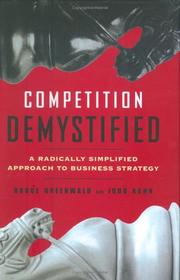
Value Investing: From Graham to Buffett and Beyond is the canonical modern restatement of the Columbia value framework, and Competition Demystified is its standard companion on barriers to entry.
Where it sits in the reference 7
Who recommended it 4 · 2 direct
Similar books 6
Chosen by shared topics, the entries that hold them, and the people who recommended both.