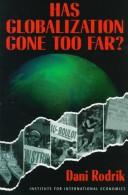
Has Globalization Gone Too Far?
The 1997 warning that the political backlash was coming.
Summary
Rodrik wrote this short book in 1997, arguing that trade liberalisation was creating social tensions that its advocates were not addressing and that the political backlash was predictable.
His argument had three parts. Trade increases the elasticity of demand for labour, which means workers bear more of the burden of any cost increase and have less bargaining power, independent of any effect on wage levels. Trade brings into competition societies with different norms about labour standards, environmental protection and social insurance, and the resulting conflicts are about legitimate differences in social arrangements rather than about protectionism. And trade openness increases the demand for social insurance while simultaneously eroding the tax base that funds it, which is a structural tension that liberalisation programmes did not address.
He was careful that he supported trade and was arguing about how it should be managed rather than whether it should occur, a distinction that was widely ignored at the time.
The book was dismissed by most economists when published and Rodrik has described the reception. Its predictions about political backlash were substantially confirmed twenty years later, and the empirical work on the China shock by Autor and others documented labour market effects of the magnitude Rodrik anticipated. Later work of his, particularly The Globalization Paradox and its trilemma between democracy, national sovereignty and deep economic integration, develops the argument further. This remains the compact early statement.
Key takeaways 7
- Trade increases the elasticity of demand for labour, which reduces worker bargaining power independently of any effect on wage levels.
- Trade brings into competition societies with different norms about labour, environment and social insurance, and the resulting conflicts are legitimate rather than protectionist.
- Openness raises the demand for social insurance while eroding the tax base that funds it, which is a structural tension liberalisation did not address.
- The political backlash against trade liberalisation was predictable from its distributional effects and was predicted.
- The gains from further trade liberalisation are small relative to the distributional consequences, which changes the balance of the argument.
- Economists dismissed distributional concerns as protectionism, which removed the profession from a debate it was needed in.
- Managing the domestic consequences of trade is a precondition for sustaining trade politically, rather than a concession to opponents.
Who should read it
Investors and policy readers who want the early and largely confirmed statement of the case that trade's distributional politics would not hold.
Where it sits in the reference 2
Who recommended it 1 · 1 direct
Similar books 6
Chosen by shared topics, the entries that hold them, and the people who recommended both.