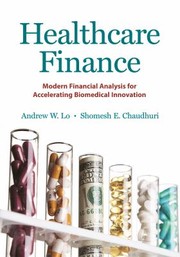
Healthcare Finance: Modern Financial Analysis for Accelerating Biomedical Innovation
Princeton University Press. Listed on Lo's MIT books page.
Summary
Lo and Chaudhuri, working from Lo's research group at MIT, wrote this to apply financial engineering to the funding of biomedical research and drug development.
The problem they address is structural. Developing a drug takes over a decade, costs enormous sums, and fails most of the time, with success probabilities that vary by therapeutic area and by development stage. This risk profile does not suit any conventional funding source: venture capital funds have horizons shorter than the development cycle, public equity markets punish the volatility, and the probability of any single programme succeeding is too low for debt financing.
Their central proposal follows from portfolio theory. A single drug programme is unfinanceable because its failure probability is high and its outcome is binary. A portfolio of many independent programmes has a far more predictable aggregate outcome, because the failures and successes average, and a large enough portfolio can support debt financing that no individual programme could. They call this a megafund, and they model the required portfolio size, the capital structure combining debt and equity tranches, and the returns available to each. The essential requirement is statistical independence across programmes, which holds better across therapeutic areas than within one.
The book also covers the estimation of success probabilities from clinical trial databases, which is the input everything depends on and which the authors have worked to improve; adaptive trial design and its effect on cost and duration; the valuation of drug programmes as sequences of real options; patient preferences incorporated into regulatory decisions; and financing structures for rare diseases where the patient population cannot support conventional pricing.
The megafund proposal has attracted attention and limited implementation. Its dependence on statistical independence and on reliable success probability estimates is the practical constraint. The book is technical and assumes financial training.
Key takeaways 7
- A single drug development programme is unfinanceable because its failure probability is high and its outcome is binary.
- A large portfolio of independent programmes has a predictable aggregate outcome that individual programmes do not.
- A sufficiently diversified portfolio can support debt financing that no individual drug programme could obtain.
- Statistical independence across programmes is the essential requirement, and it holds better across therapeutic areas than within one.
- Success probabilities estimated from clinical trial databases are the input everything in the model depends on.
- Adaptive trial designs reduce cost and duration by changing the trial in response to accumulating data.
- Drug programmes are sequences of real options, since each stage buys the right to proceed to the next.
Who should read it
Investors and operators in biotechnology and healthcare who want financial engineering applied to the funding structure of drug development.
About Andrew W. Lo
Charles E. and Susan T. Harris Professor, MIT Sloan School of Management; Director, MIT Laboratory for Financial Engineering; founder of AlphaSimplex Group
The Econometrics of Financial Markets and the variance-ratio work with MacKinlay are primary sources the field builds on, and the Adaptive Markets Hypothesis is a named framework in its own right.
Where it sits in the reference 2
Similar books 6
Chosen by shared topics, the entries that hold them, and the people who recommended both.