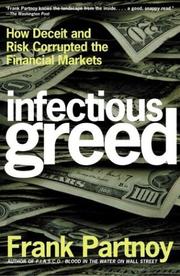
Infectious Greed
Places WorldCom in a decade of engineered corporate deception.
Summary
Partnoy, a former derivatives salesman turned law professor, traces the growth of financial risk-taking from the mid-1980s through Enron, arguing that the common thread is the deliberate use of complexity to move risk outside the reach of accounting, regulation and investor understanding.
The cases are worked in technical detail: Bankers Trust's derivatives sales to Gibson Greetings and Procter and Gamble, the Orange County bankruptcy under Robert Citron, the Barings collapse, the structured notes sold to Japanese and Southeast Asian institutions before 1997, Long-Term Capital Management, the accounting at Enron, WorldCom and Global Crossing, and the analyst conflicts of the dot-com period. Partnoy explains each instrument well enough for a reader to see what it was designed to conceal.
His legal argument is that the deregulation of derivatives, particularly the 2000 Commodity Futures Modernization Act, combined with securities law that protected issuers who disclosed in ways nobody could parse, and with accounting rules that permitted off-balance-sheet treatment, produced a system in which the most profitable financial activity was the creation of complexity itself. He argues that the incentive was never to take a risk but to move it somewhere it would not be counted.
The book was published in 2003 and reads as a prediction of 2008, which is why it retains a reputation. Partnoy writes with prosecutorial force and the sympathetic treatment of individual victims of derivatives sales sometimes understates their own sophistication. The legal and accounting detail is dated in specifics.
Key takeaways 7
- Financial complexity is frequently designed to move risk outside what accounting, regulation and investors can see, rather than to manage it.
- Derivatives sold to corporate treasurers and municipal funds were priced so that the buyer could not calculate the embedded cost, which was the source of the dealer's margin.
- The deregulation of over-the-counter derivatives removed the disclosure and exchange requirements that would have made accumulated positions visible.
- Off-balance-sheet accounting treatment created a direct commercial incentive to structure transactions for their accounting result rather than their economics.
- Individual traders at Barings and Orange County were able to accumulate catastrophic positions because the control functions did not understand the instruments.
- Securities disclosure protects issuers who publish complexity, since a document nobody can parse satisfies the legal requirement while informing no one.
- The most profitable financial activity in the period was manufacturing complexity, not bearing risk.
Who should read it
Investors and risk managers who want the technical case that complexity is often a concealment product, written five years before it was demonstrated.
About Frank Partnoy
Law professor at the University of California, Berkeley and former Morgan Stanley derivatives salesman writing on derivatives, fraud and regulation.
F.I.A.S.C.O. describes structured-derivatives selling from inside the desk that did it, naming how the trades were priced and why clients kept buying them. Infectious Greed and The Match King follow the same incentives through the accounting frauds of the 1990s and the 1920s.
Where it sits in the reference 5
Similar books 6
Chosen by shared topics, the entries that hold them, and the people who recommended both.