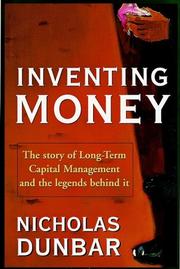
Inventing Money: The Story of Long-Term Capital Management and the Legends Behind It
More technical on the trades and the option-pricing lineage.
Summary
Nicholas Dunbar covered derivatives for Risk magazine, and he writes about Long-Term Capital Management with more technical detail about the actual positions than any other account of the episode. Roughly the first half is intellectual history: Bachelier, the development of option pricing by Black, Scholes and Merton, the growth of the swap market, and the spread of arbitrage pricing methods through the trading desks of the 1980s.
The second half covers the fund itself, from its founding by John Meriwether in 1994 through the collapse and Federal Reserve-organised recapitalisation in September 1998. Dunbar explains the trades: convergence positions in European government bonds ahead of monetary union, swap spread trades, on-the-run against off-the-run Treasuries, the Royal Dutch and Shell pair, merger arbitrage, and the large short position in long-dated equity index volatility that the fund built as its capital base grew. He shows how each individual position was defensible and how the portfolio as a whole amounted to a single bet that liquidity premia would narrow.
Dunbar's argument is that the models were not the failure. The fund's own risk system reported the positions accurately given its assumptions about correlation and about the availability of financing. What the system did not capture was that other desks had copied the same trades, that the fund's size meant it could not exit without moving prices against itself, and that its lenders would withdraw collateral terms precisely when the marks moved. Roger Lowenstein's When Genius Failed covers the same events with more character and less mathematics, and the two complement each other. Dunbar wrote before the 2008 crisis demonstrated the same mechanism at much larger scale.
Key takeaways 7
- Every Long-Term Capital position was a bet that a liquidity or risk premium would narrow, which made the portfolio one trade rather than many.
- The fund's risk models were accurate about the positions and wrong about the availability of financing during stress.
- Returning capital to investors in 1997 raised leverage on the remaining positions and reduced the buffer available a year later.
- Selling long-dated equity index volatility in size made the fund short a risk that no counterparty would take off its hands at any price.
- Competing desks replicated the fund's trades, so the positions were correlated with the balance sheets of everyone who might otherwise have bought them.
- Repo and derivative collateral terms tighten exactly when marks move against a leveraged holder, which converts a mark-to-market loss into forced liquidation.
- Dunbar argues that academic option pricing gave traders a common language and thereby made the market more correlated, not less.
Who should read it
Investors and risk managers who want the position-level mechanics of the best-documented leveraged relative-value blow-up, rather than a narrative of the personalities.
Where it sits in the reference 2
Similar books 6
Chosen by shared topics, the entries that hold them, and the people who recommended both.