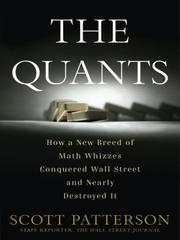
The Quants
The intellectual line from LTCM to the 2007 quant unwind.
Summary
Patterson, a Wall Street Journal reporter, follows several quantitative investors through the development of the field and into the 2007 and 2008 crises. The principal figures are Ed Thorp, who applied mathematical methods first to blackjack and then to convertible arbitrage; Ken Griffin of Citadel; Cliff Asness of AQR; Boaz Weinstein at Deutsche Bank; and Jim Simons of Renaissance, whom Patterson covers less because access was unavailable.
The intellectual history covers Thorp's beat the dealer work and Princeton Newport Partners, the development of options pricing, the statistical arbitrage strategies built on mean reversion in related securities, and the growth of quantitative funds into a substantial share of trading volume.
The central event is the August 2007 quant quake, in which quantitative equity funds suffered severe simultaneous losses over three days without any corresponding market move. Patterson explains the mechanism: many funds held similar positions derived from similar factor models, one fund deleveraging forced prices against the others, which triggered further deleveraging, and the models had no representation of this because they were calibrated on periods without it.
His analytical argument is that the models assumed normally distributed returns and independence between positions, and that both assumptions failed under stress in precisely the way Mandelbrot and Taleb had described. Patterson is a journalist and the mathematics is described rather than explained. The narrative treatment of personalities occupies space that the mechanisms would use better. Some subjects disputed his characterisations. The account of the quant quake and the crowded trade mechanism is the most valuable section.
Key takeaways 8
- Quantitative equity funds held similar positions derived from similar factor models, which made them a single crowded trade without any of them intending it.
- One fund deleveraging forced prices against the others, which triggered further deleveraging in a sequence the models had no representation of.
- Models calibrated on historical periods contain no information about events that did not occur during those periods.
- Assumptions of normally distributed returns and independence between positions both fail under stress, which is when they matter.
- Ed Thorp applied mathematical methods to blackjack and then to convertible arbitrage, establishing the template the industry followed.
- Leverage applied to strategies with small individual edges converts a modest adverse move into a solvency event.
- The August 2007 losses occurred with no corresponding move in the wider market, which showed the cause was internal to the strategies rather than external.
- Patterson describes the mathematics rather than explaining it, and the personality material occupies space the mechanisms would use better.
Who should read it
Investors who want an accessible account of quantitative strategies and the crowded trade mechanism that produced the 2007 losses.
About Scott Patterson
Reporter at The Wall Street Journal covering markets, trading technology and financial regulation.
The Quants follows Ken Griffin, Cliff Asness, Jim Simons and Boaz Weinstein through the August 2007 quant unwind and into 2008, showing how crowded factor positions liquidate against each other. Dark Pools traces the move from floor trading to automated matching and lays out the fragmented market structure that high-frequency firms operate inside.
Where it sits in the reference 7
Who recommended it 1 · 1 direct
Similar books 6
Chosen by shared topics, the entries that hold them, and the people who recommended both.