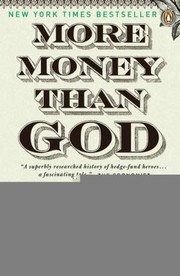
More Money Than God: Hedge Funds and the Making of a New Elite
Open Library unreachable during build; title confirmed on his CFR expert page
Summary
Mallaby writes the history of hedge funds through the individual managers who defined each era, from Alfred Winslow Jones, who created the hedged long-short structure with an incentive fee in 1949, through Michael Steinhardt's block trading, Commodities Corporation, Julian Robertson at Tiger, George Soros and Stanley Druckenmiller, Paul Tudor Jones, James Simons at Renaissance, Ken Griffin at Citadel, John Paulson's subprime trade and David Swensen's endowment allocations.
The analytical argument runs against both the industry's defenders and its critics. Mallaby holds that hedge funds are less dangerous to the financial system than banks, because they use less leverage, are not deposit-funded, and are allowed to fail without public rescue. He documents LTCM as the exception and treats the 2008 crisis as primarily a banking failure. He also argues that hedge funds provide liquidity and correct mispricings, and that the fee structure has attracted talent that would otherwise have worked at banks.
The case histories give the strategies concretely: Soros and Druckenmiller's 1992 sterling position and how it was sized, Robertson's value approach and the terminal difficulty of holding it through the technology bubble, Simons' quantitative methods described as far as anyone outside Renaissance can describe them, and Paulson's construction of the subprime short.
Mallaby had unusual access, including to Soros and Druckenmiller. The book was published in 2010 and the industry has changed considerably since, with fee compression, multi-strategy platforms and the growth of quantitative funds. His argument that hedge funds should be regulated lightly rests on the pre-2010 industry structure and would need revisiting. The history is the most complete available in one volume.
Key takeaways 8
- Alfred Winslow Jones created the structure in 1949 by combining long and short positions with leverage and a twenty percent incentive fee, and the industry has kept that shape.
- Hedge funds pose less systemic risk than banks because they run lower leverage, are not funded by deposits, and are permitted to fail.
- The 1992 sterling position succeeded on position sizing rather than on the insight, since the view was widely held and only Soros and Druckenmiller bet it at scale.
- Julian Robertson's fund failed in the technology bubble by holding a correct valuation view for longer than his investors would fund it.
- Quantitative strategies at Renaissance produced returns far beyond discretionary managers by finding many small statistically reliable patterns rather than large single bets.
- Hedge fund returns compress as capital enters a strategy, so a fund's capacity is a real limit and closing to new money is a rational decision.
- The subprime short required constructing an instrument that did not exist in sufficient size, which is why so few investors expressed the view.
- Skilled managers frequently fail not because their analysis is wrong but because their capital base cannot sustain the position long enough.
Who should read it
Investors and allocators who want the strategy-level history of the industry and a documented argument about where systemic risk actually sits.
About Sebastian Mallaby
Paul A. Volcker Senior Fellow for International Economics, Council on Foreign Relations; former Washington Post columnist and Economist correspondent
More Money Than God and The Power Law are the standard narrative histories of hedge funds and venture capital, cited far outside journalism.
Where it sits in the reference 11
Who recommended it 4 · 2 direct
Similar books 6
Chosen by shared topics, the entries that hold them, and the people who recommended both.