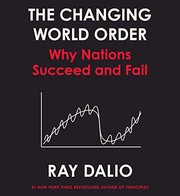
Principles for Dealing with the Changing World Order
Open Library lists the short title "Changing World Order".
Summary
Dalio studies the rise and decline of reserve currency empires, principally the Dutch, the British and the American, plus Chinese dynastic history, and proposes a repeating cycle he calls the big cycle. He argues that the pattern is driven by the interaction of a long-term debt cycle, an internal order and disorder cycle driven by wealth gaps, and an external cycle of competition between a rising power and an incumbent.
His method combines historical narrative with quantitative indices he constructs for education, innovation, competitiveness, military strength, trade share, financial centre status and reserve currency status, plotted across five hundred years. He argues that these indicators rise and fall in a consistent sequence, with reserve currency status the last to be lost because it persists long after the underlying strength has gone.
The stages he describes run from a new order after conflict, through peace and prosperity, debt accumulation, excess and bubble, debt crisis, money printing, internal conflict driven by wealth gaps, and finally external war, followed by a new order. His conclusions for the current period are that the United States sits in the late stage, that internal wealth gaps and political polarisation match the historical pattern, and that the competition with China follows the standard rising and incumbent power dynamic.
Historians criticise the compression of very different societies into one template, the constructed indices whose components are chosen by Dalio, and the confidence with which the pattern is asserted. The argument cannot be falsified in any specific period. Dalio's forecasting record from this framework has been mixed. Read it for the debt cycle mechanics and the indicator framework rather than as prediction.
Key takeaways 8
- Reserve currency empires rise and decline through a repeating sequence driven by debt cycles, internal wealth gaps and external competition.
- Reserve currency status persists long after the underlying economic and military strength that produced it has declined, which makes it a lagging rather than leading indicator.
- Long-term debt cycles end with the choice between default and monetary expansion, and governments choose expansion because default is politically impossible.
- Wealth gaps widening during the late stage of a cycle produce internal political conflict, which historically precedes external conflict.
- Education, innovation and competitiveness rise first in the sequence and decline first, which makes them the earliest available indicators.
- A rising power and an incumbent power in economic and military competition have led to war in most historical cases.
- Holding cash during periods of monetary expansion is the least safe position rather than the safest, because purchasing power erodes without any visible loss.
- The framework compresses very different societies into one template using indices Dalio constructed himself, which limits how much confidence its conclusions deserve.
Who should read it
Investors thinking about long-horizon macro positioning who want a stated framework for debt cycles and geopolitical transition, treated as a hypothesis.
About Ray Dalio
Founder and former co-CIO, Bridgewater Associates 1975-2022
Principles and the debt-cycle template are primary sources that a large secondary literature now builds on.
Where it sits in the reference 4
Who recommended it 5
Similar books 6
Chosen by shared topics, the entries that hold them, and the people who recommended both.