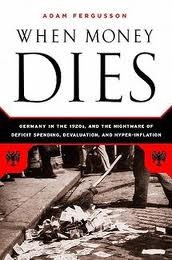
When Money Dies
The canonical narrative account of the 1923 inflation and what it did to savers and creditors.
Summary
Fergusson reconstructs the German hyperinflation of 1921 to 1923 from diaries, letters, newspaper accounts and contemporary official records, alongside shorter treatments of the parallel Austrian and Hungarian inflations. The book is descriptive rather than theoretical: it shows what happened to people, prices, wages, savings and social order as the mark went from about sixty to the dollar to over four trillion.
The mechanism Fergusson describes is a government financing deficits by discounting its own bills at the Reichsbank, an occupation of the Ruhr that removed a large part of the tax base while the government paid striking workers, and a central bank leadership that believed the depreciation was caused by the balance of payments rather than by note issue and therefore kept printing. He documents the distributional consequences precisely: fixed-income holders, pensioners, bondholders and the professional middle class were destroyed, while debtors, holders of real assets, farmers with land and industrialists with foreign currency receipts gained.
For investors the value is in the observed sequence of behaviour. Fergusson shows that people adapted slowly, that the flight from money happened suddenly and late, that wage indexation accelerated the process, and that price controls produced shortages rather than stability. The book has been criticised for weak monetary analysis, since Fergusson was a journalist and politician rather than an economist, and for drawing a straighter line from the inflation to the rise of the Nazis than the evidence supports, given that Hitler took power a decade later after a deflationary depression. Read it for the social and behavioural record.
Key takeaways 7
- The German hyperinflation was caused by the government financing its deficits through central bank note issue, and officials continued because they believed the depreciation had external causes.
- The flight from money happens abruptly and late, after a long period in which holders continue to accept the currency out of habit.
- Hyperinflation transfers wealth from creditors, pensioners and savers to debtors and holders of real assets, and the transfer is the point at which the political consequences begin.
- Indexing wages to prices accelerates the inflation rather than protecting the worker, because it removes the last lag in the process.
- Price controls during rapid inflation produce shortages, hoarding and black markets rather than lower prices.
- The professional middle class was destroyed as a class, because its wealth was held in exactly the forms inflation eliminates.
- Stabilisation, when it came, was accomplished quickly through a new currency and a hard budget constraint, which shows the problem was always fiscal rather than technical.
Who should read it
Investors who want the observed behavioural and distributional record of a currency collapse rather than a monetary theory of it.
Where it sits in the reference 4
Who recommended it 1 · 1 direct
Similar books 6
Chosen by shared topics, the entries that hold them, and the people who recommended both.