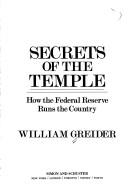
Secrets of the Temple: How the Federal Reserve Runs the Country
The Volcker Fed from the inside; still the fullest political account.
Summary
Greider, a journalist, wrote a long account of the Federal Reserve centred on the Volcker disinflation from 1979 to 1982, combined with a history of American monetary politics from the founding through the greenback and free silver movements to the creation of the Fed.
His central argument is distributional. Monetary policy allocates income between creditors and debtors, between financial and industrial capital, and between labour and capital, and Greider argues that these are political choices presented as technical necessities. He documents the Volcker period in detail: interest rates above twenty percent, the destruction of manufacturing employment and of farm and small business borrowers, the debt crisis it triggered in Latin America, and the transfer of income toward holders of financial assets. He argues the inflation was ended by imposing a recession whose costs fell on identifiable groups who had no say in the decision.
He supports this with extensive reporting on the Fed's internal deliberations, on the Federal Open Market Committee's composition and on the private-bank ownership of the regional reserve banks, which he treats as a genuine democratic problem rather than a technicality.
The book is very long and Greider's populist framing is sustained throughout. Economists generally regard his monetary analysis as weak and his account of the alternatives as insufficiently specified, since he does not seriously address what would have happened had the inflation not been broken. The reporting on the institution and the distributional analysis are the durable parts.
Key takeaways 7
- Monetary policy allocates income between creditors and debtors and between financial and industrial capital, which makes it a distributional decision presented as a technical one.
- The Volcker disinflation succeeded by imposing a severe recession whose costs fell on manufacturing workers, farmers and small borrowers who had no part in the decision.
- High American interest rates in the early 1980s triggered the Latin American debt crisis directly, since those loans were dollar-denominated and floating rate.
- The Federal Reserve's structure, including private bank ownership of the regional banks and their role in appointing officials, insulates it from democratic accountability by design.
- Inflation transfers wealth from creditors to debtors, which is why the political coalitions for and against fighting it are stable and predictable.
- The Fed's deliberations were conducted in deliberate obscurity, and the technical vocabulary functioned to exclude the public from a distributional argument.
- American monetary politics has recurred in the same form since the founding, with the greenback and free silver movements making the same distributional case.
Who should read it
Readers who want the distributional and political account of monetary policy and detailed reporting on the Volcker period, with the economics taken as contested.
Where it sits in the reference 3
Who recommended it 1 · 1 direct
Similar books 6
Chosen by shared topics, the entries that hold them, and the people who recommended both.