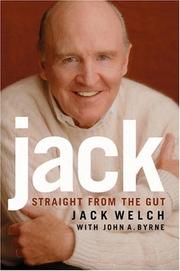
Jack: Straight from the Gut
Insider account: Welch's own version of the GE method.
Summary
Welch ran General Electric from 1981 to 2001 and wrote this memoir with John Byrne immediately after retiring. It covers his rise through the plastics business, the succession contest, and the twenty years during which GE's market value grew from around thirteen billion dollars to several hundred billion.
The management practices are stated directly. The number one or number two rule required every business to hold a leading position in its market or be fixed, closed or sold, and Welch divested or shut a large number of businesses in the early years, which produced the extensive layoffs behind his nickname. The vitality curve ranked employees into the top twenty percent, the middle seventy percent and the bottom ten percent, with the bottom removed annually. Work-Out sessions brought employees together to remove bureaucratic processes with managers required to decide on the spot. Six Sigma was adopted across the company as a quality programme. He pushed GE into services and into financial services through GE Capital, which became a substantial share of earnings.
His stated management philosophy centres on candour, on facing reality, on the removal of layers, and on the argument that leaders must have both results and values and that people with results and without values must be removed.
The book was written at the peak of Welch's reputation and before GE's decline. It says almost nothing about GE Capital's risk, about the earnings management that later analysis identified, or about the accounting practices that smoothed results across quarters. Gryta and Mann's Lights Out covers what followed. The forced ranking practice has been abandoned by most companies that adopted it.
Key takeaways 8
- Every business was required to hold a leading position in its market or be fixed, closed or sold, which drove extensive divestment and layoffs.
- Employees were ranked annually into three groups with the bottom ten percent removed, which Welch defends as the fairest available approach.
- Removing layers of management increases the speed of decisions and the accountability of the people who remain.
- Leaders must deliver both results and values, and people who deliver results while violating the values must be removed visibly.
- Bringing employees together to identify and remove bureaucratic processes, with managers required to decide immediately, was the Work-Out mechanism.
- Moving from products into services and financing changed GE's earnings profile substantially, with GE Capital becoming a major contributor.
- Candour and facing reality are stated as the two central management requirements, which Welch treats as unusual rather than as standard.
- The book predates GE's decline and says nothing about the risks in GE Capital or the earnings management that later analysis identified.
Who should read it
Executives who want the practices of the most celebrated manager of his period, read against the subsequent record of the company he built.
Where it sits in the reference 2
Who recommended it 3 · 1 direct
Similar books 6
Chosen by shared topics, the entries that hold them, and the people who recommended both.