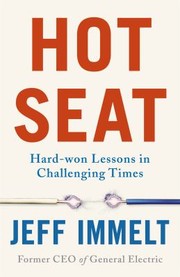
Hot Seat: What I Learned Leading a Great American Company
Insider account: Immelt's defence of his sixteen years as CEO.
Summary
Jeff Immelt became chief executive of General Electric four days before the September 2001 attacks and left in 2017 with the company's market value down by roughly half. This memoir, written with Amy Wallace, is his account and his defence. He organises it around the crises he inherited or met: the destruction of the aircraft insurance and leasing businesses after 2001, the collapse of GE Capital's funding in 2008, the Fukushima accident involving GE-designed reactors, the collapse of oil prices after 2014, and the deteriorating economics of gas turbines.
Immelt makes several substantive arguments. He says Jack Welch's GE relied heavily on GE Capital earnings and on accounting flexibility that was no longer available to him, so his GE started from a weaker base than the share price implied. He defends the decision to shrink GE Capital and to buy Alstom's power business, arguing that the industrial logic was sound even though the timing was wrong. He accepts responsibility for GE's culture of relentless optimism, in which executives filtered bad news upward, and he concedes that the digital initiative built around Predix was too broad.
The book is contested at almost every point. Thomas Gryta and Ted Mann's reporting in Lights Out documents earnings management, service-contract accounting and insurance reserve shortfalls in more damaging detail than Immelt allows. Readers should treat this as advocacy from an interested party who nonetheless had access to every decision. Its value lies in the specificity of the operating problems described, particularly the difficulty of running a finance business inside an industrial company after the funding markets change.
Key takeaways 7
- GE Capital's earnings had become load-bearing for the whole company, and no industrial performance available to Immelt could replace them.
- The GE that Immelt inherited was more fragile than its 2001 valuation suggested, because prior results depended on financial and accounting flexibility.
- A culture that punishes bad news produces forecasts that management cannot use.
- The Alstom acquisition rested on a demand forecast for gas turbines that the industry as a whole got wrong.
- Conglomerate structure is defensible only when the centre adds something the businesses cannot buy in the market.
- Immelt argues that GE's post-2008 regulatory designation as a systemically important institution made GE Capital permanently uneconomic.
- Chief executives of large public companies spend most of their time on capital allocation and succession, and Immelt says he handled the second badly.
Who should read it
Operators and investors studying conglomerate breakups, industrial companies with captive finance arms, and how a chief executive accounts for a long decline.
Where it sits in the reference 2
Similar books 6
Chosen by shared topics, the entries that hold them, and the people who recommended both.