At Any Cost: Jack Welch, General Electric, and the Pursuit of Profit
The contemporaneous dissent, twenty years ahead of the consensus.
Summary
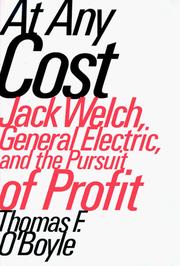
O'Boyle, a Wall Street Journal reporter, wrote a critical account of Jack Welch's General Electric at the point when Welch's reputation was at its highest.
The argument is that the financial results were produced at costs that did not appear in the accounts. O'Boyle documents the employment reduction of well over a hundred thousand people and follows specific communities where plants closed, examining what happened to the workers and to the local economies. He argues that the pressure to deliver numbers every quarter produced behaviour throughout the organisation that senior management did not intend but did create, and he documents specific episodes: the Kidder Peabody trading fraud, in which a trader recorded fictitious profits for years; the diamond price-fixing case; the defence contracting fraud settlements; and the environmental disputes, particularly the PCB contamination of the Hudson River which General Electric fought for decades.
He also examines the vitality curve, under which the bottom ten per cent of managers were removed each year, and argues that this produced a culture in which failing to make the number was not survivable, which is the precondition for the conduct he documents.
The book was published in 1998 and reads as a minority report against the consensus of the period. Much of what O'Boyle argued was subsequently vindicated: the reliance on GE Capital, the earnings management that produced the smooth results, and the eventual dismantling of the company all support his general position. Cohan's Power Failure, also in this reference, covers the same ground with the outcome known.
O'Boyle is hostile throughout and the book does not seriously engage the case that the restructuring was necessary given General Electric's position in 1981, which is the strongest argument on the other side.
Key takeaways 7
- General Electric's reported results were produced at costs to employees and communities that did not appear in the accounts.
- Removing the bottom ten per cent of managers annually created a culture in which missing the number was not survivable.
- A culture where missing targets ends careers produces the conduct that leads to fraud and to accounting manipulation.
- The Kidder Peabody episode involved a trader recording fictitious profits over years without detection.
- The company faced repeated settlements over defence contracting, price fixing and environmental contamination during the period of its highest reputation.
- Consistently smooth quarterly results at a company with this many businesses indicated management of the numbers rather than of the businesses.
- A minority report written against consensus can be substantially correct and take twenty years to be recognised.
Who should read it
Executives and investors who want the contemporaneous critical case against a celebrated management record, and the connection between performance culture and misconduct.
Where it sits in the reference 2
Similar books 6
Chosen by shared topics, the entries that hold them, and the people who recommended both.