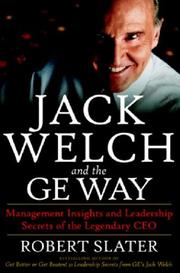
Jack Welch and the GE Way
Contemporary admiring account; useful as a record of what people believed.
Summary
Robert Slater wrote several admiring books about Jack Welch with company cooperation, and this one summarises the management methods Welch introduced at General Electric between 1981 and the late 1990s. It is organised as a set of principles rather than as a chronological history.
The methods described include the rule that every GE business must hold first or second position in its market or be fixed, sold or closed; the destruction of the strategic planning bureaucracy Reginald Jones had built; Work-Out, in which employees presented process changes to managers required to decide on the spot; boundarylessness, meaning the transfer of practices across divisions; the forced ranking system, sorting employees into top twenty, middle seventy and bottom ten per cent with the bottom group removed annually; the Six Sigma quality programme adopted in 1995; and the push into services and financing attached to industrial products.
The book is uncritical and was written with access granted on those terms. Slater reports the results GE announced without examining how they were produced, and the later disclosures about earnings management, insurance reserves and GE Capital's role in smoothing reported results are absent by publication date. Readers should treat it as a clear statement of what Welch said he was doing, useful precisely because it is the version that a generation of executives copied, and should pair it with Jeff Immelt's account, with the reporting in Lights Out, and with the academic work on forced ranking.
Key takeaways 7
- Welch required every business to hold first or second position in its market, and used that test to justify divesting roughly two hundred units.
- Removing the corporate strategic planning function transferred planning responsibility to operating managers who owned the results.
- Work-Out sessions forced managers to accept or reject employee proposals immediately and in public, which removed the option of deferral.
- Ranking employees annually and removing the bottom decile was presented as kindness, on the argument that people should learn early that they do not fit.
- Boundarylessness meant treating a practice developed in one division as an obligation for the others to adopt.
- GE attached financing and service contracts to industrial equipment, which converted one-time sales into recurring revenue.
- Slater treats GE's reported earnings consistency as evidence of managerial quality, an interpretation later disclosures have made untenable.
Who should read it
Executives who want the canonical statement of the management doctrine that dominated large American companies in the 1990s, read with awareness of what it omits.
Where it sits in the reference 2
Similar books 6
Chosen by shared topics, the entries that hold them, and the people who recommended both.