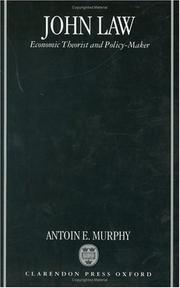
John Law
The scholarly treatment of Law as economic theorist and policymaker.
Summary
Antoin Murphy, an economist at Trinity College Dublin, wrote this as a rehabilitation of John Law's reputation as a monetary theorist. Law is remembered for the Mississippi Company and the French financial collapse of 1720, and Murphy argues that the theory behind the scheme was serious and in several respects anticipated later monetary economics.
Murphy reconstructs Law's thought from Money and Trade Considered and from his earlier proposals to the Scottish and Savoyard authorities. Law argued that money is a means of exchange rather than a store of value, that the quantity of money determines the level of activity in an economy operating below capacity, and that a paper currency backed by land or by a productive enterprise could expand supply without the constraint that metal imposed. Murphy traces how this became the System in France: the Banque Generale and then Banque Royale issuing notes, the Mississippi Company acquiring the tax farms and the trading monopolies, and the conversion of the French government's short-term debt into company shares.
The analytical point Murphy makes is that Law's scheme was an early debt-for-equity conversion at national scale, and that its failure came from the interaction between the share price and the note issue rather than from the underlying idea. When shareholders sold, Law supported the price with notes, which produced inflation, which produced further selling. The book is scholarly and demands attention to eighteenth-century finance. Murphy is a partisan for his subject, and readers should note that his revaluation is more generous than most economic historians accept.
Key takeaways 7
- Law argued that money is a means of exchange rather than a store of value, and that increasing its supply raises output in an underemployed economy.
- The Mississippi System was a conversion of French government debt into equity in a monopoly trading and tax-farming company.
- Law's fatal error was supporting the share price with note issuance, which linked the currency's value to the equity market.
- Paper money detached from metal allows an economy to expand its money supply with activity, and Law identified this before the theory existed.
- The System's collapse discredited banking in France for a century and delayed the development of French financial institutions.
- Murphy argues that Law was a theorist implementing a coherent programme rather than a gambler improvising.
- Combining the note-issuing bank and the equity company under one management removed the check that separate institutions would have provided.
Who should read it
Investors and financial historians interested in the intellectual origins of paper money and in the first large-scale attempt to convert sovereign debt into equity.
Where it sits in the reference 2
Similar books 6
Chosen by shared topics, the entries that hold them, and the people who recommended both.