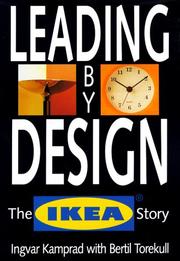
Leading by Design: The IKEA Story
Insider account: built on long interviews with founder Kamprad.
Summary
Torekull, a Swedish business journalist, wrote this with Ingvar Kamprad's cooperation, combining a company history with long interview passages in which Kamprad speaks directly.
The business content traces IKEA from Kamprad's mail-order operation in Smaland in the 1940s through the decisions that defined the model. Furniture retailers' suppliers boycotted IKEA under pressure from the established trade, which forced Kamprad to source from Poland, and that constraint became a permanent cost advantage. A designer removed a table's legs to fit it in a car, which produced flat packing and self-assembly, which in turn reduced shipping cost, storage cost and assembly labour simultaneously. Locating stores outside city centres reduced property cost and required the destination shopping trip that the catalogue and the store layout were then built to justify. The catalogue functioned as the primary marketing instrument for decades.
The cultural material covers Kamprad's frugality, which he practised personally and enforced as company doctrine, the written statement of values he called the testament of a furniture dealer, and the ownership structure through a Dutch foundation that placed the company beyond takeover and outside conventional taxation.
The book also addresses Kamprad's involvement with a Swedish pro-Nazi movement in his youth, which he had disclosed to employees in 1994, and his alcohol problem. He is candid about both within limits.
This is an authorised account produced with the subject's participation, so it presents his framing. It says little about supplier conditions, about the tax structure's function, or about the succession arrangements. It ends in the late 1990s and does not cover the global expansion, the Chinese and Indian entries, or the disputes over the ownership structure that emerged later.
Key takeaways 7
- A supplier boycott by the established furniture trade forced IKEA into Polish sourcing, which became a permanent cost advantage.
- Flat packing reduced shipping cost, storage cost and assembly labour simultaneously, which is why one packaging decision restructured the whole model.
- Out-of-town locations reduced property cost and required the store and catalogue to justify a destination trip.
- Kamprad enforced personal frugality as company doctrine on the argument that cost consciousness cannot be delegated to a budget process.
- Designing to a price point first and then engineering the product to meet it reverses the conventional sequence.
- The foundation ownership structure placed the company beyond takeover and outside conventional corporate taxation.
- Written statements of company values transmitted the founder's method as the organisation grew beyond his direct reach.
Who should read it
Retail and consumer operators who want the founder's account of how a set of cost constraints produced a durable business model.
Where it sits in the reference 3
Similar books 6
Chosen by shared topics, the entries that hold them, and the people who recommended both.