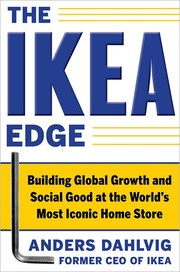
The IKEA Edge
Insider account: the CEO from 1999-2009 on the operating model.
Summary
Dahlvig ran IKEA as chief executive from 1999 to 2009, during which revenue roughly tripled, and this is his account of how the company was managed and what he thinks makes it work.
The business substance covers IKEA's operating model: designing to a price point first and then engineering the product to meet it; flat-pack construction that transfers assembly labour and transport volume to the customer; owning the whole chain from design through range through retail so that cost decisions can be made across it rather than negotiated between parties; store formats and locations chosen for land cost rather than for footfall; and the deliberate strategy of lowering prices annually rather than raising them, funded by cost reduction that must therefore be continuous.
Dahlvig also covers the internal management: the culture derived from Ingvar Kamprad's Smaland origins, the emphasis on cost consciousness at every level including executive travel, the decentralised country management within a tightly controlled range and supply chain, and the ownership structure through a foundation that removes external shareholder pressure and permits long-horizon decisions.
The final section argues for what he calls a broader business model in which social and environmental responsibility, employee relations and community position are treated as commercial requirements rather than as constraints.
The book is a chief executive's account of his own tenure and is favourable to it. It is thin on the periods of difficulty and on the criticisms of IKEA's tax structure, supplier labour practices and environmental record. The operating model description is accurate and useful.
Key takeaways 7
- IKEA designs to a price point first and engineers the product to meet it, which reverses the normal sequence and constrains every subsequent decision.
- Flat-pack construction transfers assembly labour and shipping volume to the customer, which removes cost from the parts of the chain the company pays for.
- Owning design, range and retail together allows cost decisions to be optimised across the whole chain rather than negotiated between separate parties.
- Committing to lower prices every year forces continuous cost reduction, since the price commitment cannot be met any other way.
- A foundation ownership structure removes external shareholder pressure and permits investment decisions on horizons a listed company cannot use.
- Country management should be decentralised while range and supply chain remain tightly centralised, since the first requires local knowledge and the second requires scale.
- Cost consciousness must be visible at executive level or it will not be taken seriously anywhere else in the organisation.
Who should read it
Retail and consumer operators interested in vertically integrated low-cost models and the ownership structures that permit long-horizon decisions.
Where it sits in the reference 4
Similar books 6
Chosen by shared topics, the entries that hold them, and the people who recommended both.