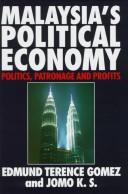
Malaysia's Political Economy: Politics, Patronage and Profits
The canonical mapping of party-linked ownership across corporate Malaysia.
Summary
Edmund Terence Gomez and Jomo Kwame Sundaram examine how Malaysian economic policy distributed ownership and rents between ethnic communities and between political factions. The central subject is the New Economic Policy introduced in 1971 after the 1969 riots, which set targets for Bumiputera ownership of corporate equity and directed state resources toward achieving them.
The authors argue that the policy's redistributive goals were substantially captured. Rather than creating a broad Malay business class, the state's instruments, including trust agencies, directed share allocations, licences and later privatisation, transferred assets to individuals connected to the ruling party. Gomez traces the corporate ownership networks in detail, showing how party-linked holding companies, nominee arrangements and politically connected businessmen of all ethnicities held the assets that official statistics counted toward the ownership targets. The privatisation programme of the 1980s and 1990s under Mahathir accelerated this, since assets were transferred by negotiation rather than by auction.
The book combines political analysis with corporate ownership research, and the ownership mapping is its distinctive contribution. It was published in 1997, immediately before the Asian financial crisis, which tested the arrangements it describes and produced the Anwar Ibrahim conflict. Gomez has continued the research since, most recently in Minister of Finance Incorporated. Readers should treat this as the foundational study of Malaysian business-government relations rather than as a current account.
Key takeaways 7
- Malaysia's ethnic redistribution policy transferred corporate assets to politically connected individuals rather than creating a broad Bumiputera business class.
- Official Bumiputera ownership statistics counted assets held by trust agencies and nominees, which conceals who actually controlled them.
- Privatisation by negotiated transfer rather than by auction converted a redistribution programme into a patronage mechanism.
- Political parties in Malaysia held corporate assets directly through holding companies, which made party finance and business ownership the same activity.
- Ethnic Chinese business groups adapted by acquiring political partners, so the policy restructured rather than reduced their position.
- Rent distribution through licences and contracts creates constituencies that block the policy's own stated sunset.
- Gomez argues that studying corporate ownership networks reveals political structure more accurately than studying formal institutions does.
Who should read it
Investors in Southeast Asia and analysts of state-directed redistribution who want a detailed mapping of political ownership in a middle-income economy.
Where it sits in the reference 2
Similar books 6
Chosen by shared topics, the entries that hold them, and the people who recommended both.


