Minister of Finance Incorporated
Who actually controls the GLCs that dominate the local market.
Summary
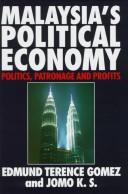
Edmund Terence Gomez and colleagues examine ownership and control of Malaysia's largest companies, focusing on the entity Minister of Finance Incorporated, which holds government stakes in a wide range of businesses, and on the government-linked investment companies including Khazanah, the Employees Provident Fund and Permodalan Nasional Berhad.
The research maps who owns what. The authors trace shareholdings through the layers of holding companies to show the extent of state ownership across Malaysian listed equity, and they document how board appointments to these companies are made and by whom. Their argument is that Malaysian corporate ownership has been progressively re-concentrated in state hands since the 1990s, reversing the privatisation of the earlier period, and that control over these assets is exercised through the finance ministry rather than through any independent governance structure.
The book was published in 2017, shortly before the 2018 election that removed the government and brought the 1MDB affair fully into the open. The 1MDB scandal, in which billions were taken from a fund whose sole shareholder was Minister of Finance Incorporated, is the most direct demonstration of the governance problem the authors describe, and the book's analysis anticipates it. The research is detailed and the ownership mapping is its contribution; readers wanting narrative of the 1MDB affair should go elsewhere.
Key takeaways 7
- Malaysian state ownership of listed equity increased after the 1990s, reversing the earlier privatisation programme.
- Minister of Finance Incorporated holds government stakes directly and reports to the finance minister rather than to any independent board.
- Combining the offices of prime minister and finance minister concentrates control of state corporate assets in one person.
- Government-linked investment companies hold enough of the Malaysian market to make the state the dominant shareholder in the economy.
- Board appointments at government-linked companies function as political patronage, which determines whose interests those boards serve.
- The authors argue that ownership mapping reveals the real structure of economic power more accurately than policy analysis does.
- Concentrated state ownership without independent governance creates the conditions the 1MDB affair exploited.
Who should read it
Investors in Malaysian equities and analysts of state capitalism who want a documented map of who controls the country's largest companies.
Where it sits in the reference 2
Similar books 6
Chosen by shared topics, the entries that hold them, and the people who recommended both.