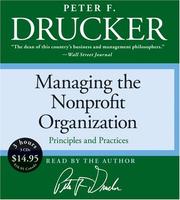
Managing the Non-Profit Organization
Summary
Peter Drucker consulted for non-profit institutions throughout his career and wrote this as a practical treatment of their specific management problems. It combines his own chapters with interviews he conducted with practitioners including Frances Hesselbein of the Girl Scouts and executives of hospitals, churches and universities.
His analytical starting point is that a non-profit has no bottom line, so it cannot use financial results to test whether it is doing the right things. Everything therefore depends on defining the mission with enough precision to be operational, and Drucker is severe about mission statements that state good intentions rather than specify what the organisation will accomplish and for whom. He argues that a mission must fit on a T-shirt and must permit the organisation to say what it will not do.
The remaining sections cover leadership, which he treats as work rather than as charisma; marketing and fundraising, where he insists that the donor is a customer whose satisfaction must be managed; the management of volunteers, whom he treats as unpaid staff requiring the same clarity of role and performance expectation as employees; and the development of the individual, including board members. The book's argument about volunteers anticipated his later claim that knowledge workers in businesses must be managed the same way. It is practical rather than theoretical and remains widely used in the sector.
Key takeaways 7
- A non-profit has no financial result to test its decisions, so an operational mission statement is the only available control.
- A mission must specify what the organisation will not do, or it provides no basis for allocating resources.
- Donors are customers whose satisfaction must be managed, and treating fundraising as begging guarantees that it fails.
- Volunteers must be managed as unpaid staff with defined roles and performance expectations, because they leave when the work is meaningless.
- Leadership is defined by results and by responsibility rather than by personal qualities.
- Non-profits should abandon programmes that no longer serve the mission, and their difficulty in doing so exceeds that of businesses because failure feels like betrayal.
- Drucker argues that the management practices non-profits need are the ones businesses will need as knowledge work grows.
Who should read it
Anyone leading or governing a mission-driven organisation, and executives managing people whose commitment is voluntary rather than contractual.
About Peter F. Drucker
Management writer and consultant; professor at Bennington, NYU and Claremont Graduate University
He invented management as a field of study, and The Practice of Management and The Effective Executive remain the primary sources every later writer builds on.
Where it sits in the reference 2
Similar books 6
Chosen by shared topics, the entries that hold them, and the people who recommended both.