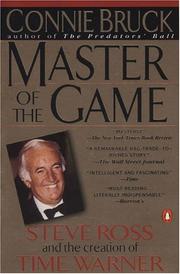
Master of the Game: Steve Ross and the Creation of Time Warner
How Ross built the conglomerate and forced the Time merger.
Summary
Bruck follows Steve Ross from a funeral home business and a parking company through the assembly of Warner Communications and the 1989 merger with Time Inc that created what was then the largest media company in the world.
The deal-making material is the substance. Ross built the company through acquisitions financed with stock, moving from parking and funeral services into talent agencies, then into Warner Bros, records, publishing and cable. Bruck documents the specific structures, including the use of contingent payments and stock that valued the target on future performance, and Ross's practice of leaving acquired managers in place with unusual autonomy and extraordinary compensation.
The Time Warner merger is covered in detail, including the initial agreement, Paramount's competing bid, the restructuring of the transaction into an acquisition financed with debt to avoid a shareholder vote, and the litigation that followed. Bruck documents that the resulting debt load constrained the company for years and that the terms Ross secured for himself were extraordinary relative to what shareholders received.
The personal material covers Ross's charm, which Bruck treats as a business instrument, his generosity toward people who were useful to him, and the investigations into the Westchester Premier Theatre and its connections. Bruck is a rigorous reporter and the book is unsympathetic in places. The account of executive compensation and of the merger terms is documented rather than asserted. It is long and the level of transactional detail will lose readers not interested in deal structure. The material on how personal relationships function as a deal-making asset is what transfers.
Key takeaways 8
- Ross built the company through acquisitions financed with stock, moving from parking and funeral services into entertainment.
- Contingent payments and stock valued on future performance let an acquirer buy businesses it could not have afforded to pay for in cash.
- Leaving acquired managers in place with unusual autonomy and extraordinary compensation is what allowed serial acquisition in a talent business.
- Personal relationships functioned as a deal-making asset that competitors with better financial terms could not match.
- The Time Warner transaction was restructured into a debt-financed acquisition to avoid a shareholder vote after a competing bid appeared.
- The resulting debt load constrained the combined company for years, which was a direct consequence of the structure chosen to defeat the competing bid.
- Executive compensation terms secured in the merger were extraordinary relative to what shareholders received from the same transaction.
- A merger presented as a combination of equals became an acquisition when the structure was changed to defeat a rival bidder.
Who should read it
Investors and executives interested in acquisition structures, media consolidation and how deal terms diverge between executives and shareholders.
About Connie Bruck
Staff writer at The New Yorker reporting on finance, media and politics.
The Predators' Ball is the primary account of Michael Milken's high-yield bond operation at Drexel Burnham Lambert and of the buyer network that financed the 1980s takeover wave, reported while the participants were still talking. Master of the Game follows Steve Ross from a funeral-home business to the Time Warner merger and sets out the compensation arrangements he negotiated at each step.
Where it sits in the reference 3
Who recommended it 2 · 1 direct
Similar books 6
Chosen by shared topics, the entries that hold them, and the people who recommended both.