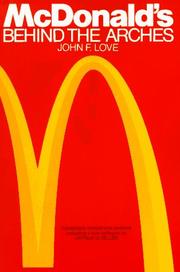
McDonald's: Behind the Arches
The standard business history of the franchise and property model.
Summary
Love had full access to McDonald's records and to the surviving principals, and the result is one of the most detailed corporate histories written. It covers the McDonald brothers' original San Bernardino operation, Ray Kroc's acquisition of the franchising rights and then the name, the construction of the supplier network, the real estate strategy, and the franchise system's evolution through the 1980s.
The most important finding concerns where the money actually came from. Harry Sonneborn's insight was that McDonald's should lease sites and sublease them to franchisees at a markup, which made the company a real estate business collecting rent that rose with franchisee sales. That structure funded expansion and gave headquarters leverage over operators who would otherwise have been independent. Love also documents the supplier strategy: McDonald's built relationships with small suppliers who would grow with it rather than buying from established food companies, and it invested in their process innovation, including frozen fries and the automated equipment that made consistency possible.
The third theme is that most of the products were invented by franchisees, including the Big Mac, the Filet-O-Fish and the Egg McMuffin, and that headquarters' role was to test and standardise rather than to originate. For operators the book is a case study in building a system where the incentives of independent operators, suppliers and the parent are aligned, and where the parent captures value from real estate rather than from product margin. It ends in the mid-1980s and does not cover the later international expansion, the franchisee conflicts of the 1990s, or the current business.
Key takeaways 7
- McDonald's made its money as a real estate company, leasing sites and subleasing them to franchisees at a markup that rose with sales.
- The real estate structure gave headquarters enforcement power over franchisees that a pure trademark licence could never have provided.
- McDonald's built its supply chain from small suppliers who grew with the company, rather than buying from established food companies who would not change their processes.
- Most successful menu items originated with individual franchisees, and headquarters' contribution was testing, standardising and distributing them.
- Ray Kroc's insistence on operational consistency across independent operators was enforced through inspection, training and the threat of losing the lease.
- Franchisees were selected as owner-operators who would work in the store, not as passive investors, which determined the quality of execution.
- Equipment and process innovation, including the frozen french fry, was the technical foundation of the consistency the brand promised.
Who should read it
Founders and operators building franchise, multi-unit or partner-dependent businesses who need a detailed account of aligning independent operators with a parent company.
Where it sits in the reference 4
Who recommended it 1 · 1 direct
Similar books 6
Chosen by shared topics, the entries that hold them, and the people who recommended both.