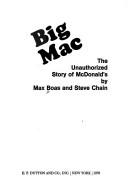
Big Mac: The Unauthorized Story of McDonald's
Early unauthorised account of the franchise and real-estate machine.
Summary
The reference has not verified this book in detail; the summary states only what the title, author and subject establish.
Boas and Chain wrote a critical account of McDonald's in 1976, when the company was expanding rapidly and before it became the subject of extensive business literature.
The reference has not verified the book's detailed contents. What the title and period establish is that this is an early unauthorised treatment, written from a position critical of the company, covering the Kroc period during which McDonald's grew from a regional franchise operation into a national chain.
The territory such an account covers includes the origins with the McDonald brothers' San Bernardino restaurant and Ray Kroc's acquisition of the franchising rights and later of the company itself; the operating system, meaning the standardisation of product, process and equipment that made consistency possible across thousands of outlets; the franchise model and the relationship between the company and its operators, including the real estate arrangement under which McDonald's owns or leases the sites and sublets them to franchisees, which is the actual source of the company's economics; the supply chain relationships with dedicated suppliers; the labour model based on low-skill, high-turnover employment at minimum wage; the marketing directed at children; and the nutritional characteristics of the food.
A critical account from 1976 would emphasise the labour practices, the effect on independent restaurants, the marketing to children and the food itself. Schlosser's Fast Food Nation covered similar ground twenty-five years later with more research.
Readers should verify the book's specific claims, which are from a period when the company was less documented than it later became.
Key takeaways 7
- McDonald's economics rest on real estate, since the company controls the sites and sublets them to franchisees.
- Standardisation of product, process and equipment is what made consistent output possible across thousands of independent operators.
- Ray Kroc acquired the franchising rights from the McDonald brothers and later bought the company and the name from them.
- The labour model depends on low-skill work that requires minimal training, which permits high turnover without operational damage.
- Dedicated supplier relationships gave the company control over inputs that arm's length purchasing would not have provided.
- Marketing directed at children was a deliberate strategy that drew criticism from the company's early expansion onward.
- The account is from 1976 and its specific claims should be verified against later documented sources.
Who should read it
Readers interested in early critical coverage of McDonald's, who should use later researched accounts for the substance.
Where it sits in the reference 2
Similar books 6
Chosen by shared topics, the entries that hold them, and the people who recommended both.