Models.Behaving.Badly.
A quant on confusing models with reality, in finance and life
Summary
Derman, a theoretical physicist who became a quantitative analyst at Goldman Sachs, distinguishes three things that get confused in finance: theories, models and intuition. A theory, in his usage, describes the world as it actually is and can be tested against it, as Maxwell's equations or Dirac's are. A model is an analogy, a statement that one thing behaves somewhat like another, and it is always partly wrong. Intuition is direct understanding of a system from the inside.
His argument is that physics has theories and finance has only models, and that the practice of treating financial models as though they were theories caused enormous damage. He works through the Black-Scholes model, which he regards as the best model finance has, and shows that its value lies in giving a common language for translating price into implied volatility rather than in telling you what an option is worth. He is explicit that the assumptions do not hold and that practitioners already know this and adjust, which is what the volatility smile is.
The book mixes this argument with autobiography, including his childhood in apartheid South Africa, his physics career and his Jewish intellectual formation, and with philosophical material drawn from Spinoza. That structure makes it unusual and some readers find the personal sections a distraction from the argument. For investors the useful content is compact: know what a model assumes, know that it is an analogy, do not confuse calibrating a model with validating it, and treat any model output as a translation rather than a fact. Derman's Financial Modelers Manifesto, included in the book, states the position in a page.
Key takeaways 7
- Financial models are analogies rather than theories, so they can be useful and are never true in the way physical laws are.
- Black-Scholes is valuable because it provides a common language for converting price into implied volatility, not because it computes correct option values.
- Calibrating a model to observed prices demonstrates flexibility, not validity, and practitioners routinely mistake one for the other.
- The persistent volatility smile is direct evidence that the market rejects the model's own assumptions while continuing to use its language.
- Financial models fail because the objects they describe, being human expectations, change in response to the model itself.
- Model users should state assumptions explicitly and know what has been swept aside, because the discarded elements are where the losses come from.
- Intuition, meaning direct understanding of a market from inside it, cannot be replaced by a model and is what tells a user when the model has stopped applying.
Who should read it
Investors, risk managers and anyone building quantitative models who needs a clear statement of what a financial model can and cannot tell them.
About Emanuel Derman
Director of the financial engineering programme at Columbia University; earlier a physicist and head of quantitative strategies at Goldman Sachs.
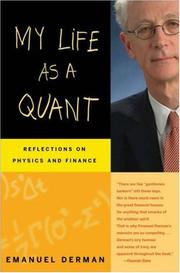
My Life as a Quant describes how derivatives modelling was actually built on a trading floor, including the local volatility model Derman developed with Iraj Kani to fit the smile left after 1987. Models.Behaving.Badly states the limit of that work directly: financial models are approximations fitted to human behaviour, not physical laws, and treating them as laws is a specific way to lose money.
Where it sits in the reference 4
Who recommended it 1
Similar books 6
Chosen by shared topics, the entries that hold them, and the people who recommended both.