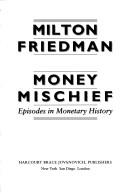
Money Mischief
Monetary episodes as short essays; the accessible way into Friedman.
Summary
Friedman collected essays on monetary history and theory, written for general readers, each using a historical episode to make a theoretical point.
The opening essay describes the stone money of Yap, where large immovable limestone discs served as currency and ownership transferred without the stone moving, including one stone lying on the sea floor that no living person had seen. Friedman uses it to argue that money is a social convention about claims rather than a physical substance, and connects it to the Bank of France's request in 1932 that the Federal Reserve mark gold in its vaults as French property, which triggered monetary contraction without any gold moving.
The longest essay concerns the Crime of 1873, the American demonetisation of silver. Friedman reconstructs the counterfactual and argues, using the price data, that had the United States retained bimetallism the country would have moved to a silver standard, prices would have risen rather than fallen through the 1870s and 1880s, and the deflation that drove the populist movement would not have occurred. He treats this as evidence that a decision made almost inadvertently shaped decades of politics.
Other essays cover Franklin Roosevelt's silver purchase programme and its effect on China, which was on a silver standard and was pushed into deflation and then off silver; the Chilean and Israeli experiences with indexation; and the general proposition, stated throughout, that inflation is always and everywhere a monetary phenomenon produced by money growing faster than output.
Friedman's monetarist framework has not held up in its strong form. The relationship between monetary aggregates and inflation broke down empirically in the 1980s and 1990s, velocity proved unstable, and central banks abandoned monetary targeting. The historical essays remain valuable and the counterfactual reasoning in the silver essay is a model of the method. Readers should treat the theoretical claims as one position in a settled debate rather than as established.
Key takeaways 7
- Money is a social convention about claims rather than a physical substance, which the Yap stone currency demonstrates directly.
- The American demonetisation of silver in 1873 caused the deflation of the following two decades and the political movement that responded to it.
- Counterfactual reconstruction using price data can establish what a different monetary decision would have produced.
- American silver purchases in the 1930s forced deflation on China, which was then on a silver standard, and drove it off the standard.
- Inflation is produced by money growing faster than output, and Friedman treats every historical inflation as an instance of this.
- Indexation reduces the distortions inflation causes but also removes the political pressure to stop it.
- Monetary decisions taken for technical or inadvertent reasons have shaped politics for decades afterward.
Who should read it
Readers who want monetary history taught through specific episodes, with the theoretical framework treated as a contested position rather than settled.
About Milton Friedman
Economist at the University of Chicago and the Hoover Institution who led the monetarist school and won the 1976 Nobel prize.
A Monetary History of the United States, written with Anna Schwartz, established that the Federal Reserve's contraction of the money supply turned the 1929 downturn into the Depression, and it set the terms of monetary policy argument ever since. Capitalism and Freedom and Free to Choose make the political case for markets and supply the standard arguments on floating rates, schooling and regulation.
Where it sits in the reference 3
Similar books 6
Chosen by shared topics, the entries that hold them, and the people who recommended both.