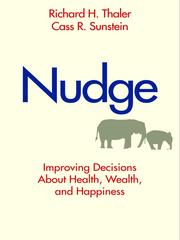
Nudge: Improving Decisions About Health, Wealth, and Happiness
Nudge: The Final Edition published 2021.
Summary
Thaler and Sunstein propose libertarian paternalism: since any way of presenting a choice will influence what people pick, the person who designs the presentation should arrange it so that people who do not think hard end up better off, while leaving anyone free to choose otherwise. They call the designer a choice architect and the intervention a nudge.
The applications are specific. They propose automatic enrolment in retirement plans with opt-out rather than opt-in, and the Save More Tomorrow programme that commits employees to raise contribution rates out of future pay rises. They cover organ donation defaults, prescription drug plan design, mortgage disclosure, energy use feedback, and school choice. Each rests on evidence that defaults, framing, salience, social comparison and the timing of a decision change outcomes substantially even when the economic incentives are unchanged.
The book changed government practice, producing behavioural insights units in Britain, the United States and elsewhere. It has also taken heavy fire. Some of the underlying psychology literature failed to replicate, and several widely cited nudge effects shrank or disappeared under larger trials and publication bias correction. Critics argue that nudges deliver small effects on problems that need structural fixes, and that the paternalism is not as libertarian as claimed once the state is choosing the default. The retirement savings evidence, which is the strongest case in the book, has held up. The final edition, published in 2021, responds to some of these criticisms and drops material the authors no longer defend.
Key takeaways 7
- There is no neutral way to present a choice, so someone is always making a design decision that affects what people pick.
- Default options determine outcomes for the majority of people in most decisions, because inertia dominates deliberate choice.
- Automatic enrolment with opt-out raises retirement plan participation far more than education or matching incentives do.
- Committing people in advance to save more out of future income increases will raise savings rates, because it avoids any felt loss in current pay.
- People make systematically worse choices in decisions that are infrequent, complex and slow to give feedback, which identifies where nudges are worth applying.
- Nudges should preserve the option to choose otherwise at low cost, which is what distinguishes them from mandates.
- Making information salient and comparable at the moment of decision changes behaviour more than disclosing the same information in a document.
Who should read it
Operators designing onboarding, pricing pages, benefits or any decision flow, and policy-minded readers who want the original statement of choice architecture.
About Richard H. Thaler
Charles R. Walgreen Distinguished Service Professor of Behavioral Science and Economics, University of Chicago Booth School of Business; co-founder, Fuller & Thaler Asset Management; Nobel laureate in economics 2017
The Anomalies series and Nudge are the primary sources for behavioral economics as an applied discipline in finance and public policy.
Where it sits in the reference 4
Who recommended it 1
Similar books 6
Chosen by shared topics, the entries that hold them, and the people who recommended both.