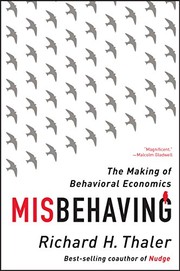
Misbehaving: The Making of Behavioral Economics
How behavioural economics won the argument, told by the man who ran it.
Summary
Thaler writes the intellectual history of behavioural economics as a personal account of building the field against sustained resistance from economists who held that departures from rational behaviour would cancel out in aggregate.
The substantive economics covers the endowment effect, which he demonstrated with mugs in classroom experiments showing that ownership raises valuation immediately; mental accounting, which describes how people treat money as non-fungible depending on which mental category it occupies; transaction utility, meaning the pleasure or displeasure derived from the deal itself independent of the item; the failure of the sunk cost principle in actual behaviour; self-control problems and the planner and doer model; fairness constraints on market behaviour, demonstrated by experiments showing that consumers punish price increases they consider unfair even when the market clears; and behavioural finance including the Value Line anomaly and the excess volatility findings with Shiller.
He describes the practical applications including the Save More Tomorrow programme, which used automatic escalation of contribution rates to raise savings, and the nudge unit work in the United Kingdom. The narrative of resistance is instructive. Thaler documents the specific objections economists raised, including that incentives would eliminate the errors, that markets would arbitrage them away, and that learning would correct them, and he records how each was addressed.
The book overlaps heavily with Nudge and with Kahneman's work. Some behavioural findings have replicated poorly and Thaler's field has faced the same scrutiny as the rest of psychology. The account of how an academic field is built against an entrenched position is the part with the widest application.
Key takeaways 8
- People value an item more once they own it, which means ownership itself changes valuation independently of anything about the item.
- Money is treated as non-fungible and assigned to mental categories, which produces spending and investing decisions that violate basic economic assumptions.
- The pleasure of getting a good deal is separate from the value of the item, which means transaction terms affect purchase decisions independently of what is purchased.
- Sunk costs affect actual behaviour despite the principle that they should not, and the effect persists among people who know the principle.
- Consumers punish price increases they consider unfair even when demand exceeds supply, which constrains market clearing in practice.
- Automatic enrolment and automatic escalation raise retirement savings far more than education or incentives do, because they change the default rather than the reasoning.
- Standard objections that incentives, markets and learning would eliminate behavioural errors were tested and did not hold.
- Small changes to how a choice is presented produce large changes in what people select, which makes the design of defaults a substantive decision.
Who should read it
Investors and operators who want the history and the economics of behavioural findings from the person who built the field.
About Richard H. Thaler
Charles R. Walgreen Distinguished Service Professor of Behavioral Science and Economics, University of Chicago Booth School of Business; co-founder, Fuller & Thaler Asset Management; Nobel laureate in economics 2017
The Anomalies series and Nudge are the primary sources for behavioral economics as an applied discipline in finance and public policy.
Where it sits in the reference 6
Who recommended it 3 · 1 direct
Similar books 6
Chosen by shared topics, the entries that hold them, and the people who recommended both.