The Investor's Shelf — one book
Thinking, Fast and Slow

Thinking, Fast and Slow

Daniel Kahneman
2011
T3 528 pages · about 8h 48m to read OL15992072Wgoodreads

Kahneman's synthesis of behavioral economics is the cognitive science underpinning every negotiation tactic. Anchoring, loss aversion, framing effects, and the planning fallacy — understanding why these biases operate, not just that they exist, makes you harder to exploit and more honest about your own irrationality.

Summary

Kahneman sets out two modes of thought. System 1 runs fast, automatically and without a sense of effort. System 2 runs slowly, allocates attention and is lazy about checking System 1. Most of the book shows how System 1 substitutes easy questions for hard ones, producing predictable errors that survive expertise, incentives and warnings.

The material rests on decades of experiments Kahneman ran with Amos Tversky, plus later work on prospect theory, the planning fallacy, and the difference between the experiencing self and the remembering self. Prospect theory, which won Kahneman the 2002 Nobel Prize in economics, states that people value outcomes relative to a reference point, feel losses roughly twice as strongly as equivalent gains, and overweight small probabilities. The book also covers regression to the mean, base rate neglect, anchoring, availability and overconfidence, each with the study that established it.

The chapters on overconfidence apply directly to investing. Kahneman describes the illusion of validity, in which confident forecasts persist despite records showing no skill, and reports his finding that a firm's stock pickers showed year-to-year correlations near zero. He recommends the outside view, reference class forecasting and the premortem as practical corrections. He is explicit that knowing about a bias does not remove it in yourself, and that institutions can improve decisions more reliably than individuals can.

The replication crisis hit parts of the book hard. The priming chapter is the weakest section, and Kahneman himself later conceded that he had placed too much confidence in underpowered studies. Ego depletion has largely failed to replicate. The core findings on prospect theory, anchoring and judgment under uncertainty have held up better. Read the priming material with suspicion and the loss aversion material as solid.

Key takeaways 8

  1. Judgment runs on two systems, and the fast automatic one produces answers that the slow deliberate one usually accepts without checking.
  2. People evaluate outcomes as gains and losses from a reference point rather than as final states of wealth.
  3. Losses hurt roughly twice as much as equivalent gains please, which explains why investors hold losers and sell winners.
  4. When a question is hard, the mind silently substitutes an easier one and answers that instead.
  5. Confidence in a judgment reflects the coherence of the story a person has constructed, not the amount or quality of the evidence behind it.
  6. Forecasters in many professional fields, including stock selection, show skill indistinguishable from chance while remaining certain of their ability.
  7. Simple statistical rules outperform expert intuition in noisy, low-validity environments.
  8. The remembering self judges an experience by its peak and its ending, not by its duration, so people choose experiences their experiencing self would reject.

Who should read it

Anyone making repeated decisions under uncertainty who wants the underlying research rather than a secondhand list of biases.

About Daniel Kahneman

Eugene Higgins Professor of Psychology Emeritus, Princeton University; Nobel laureate in economics 2002

Prospect theory and the heuristics-and-biases programme are the primary psychological foundation the whole of behavioral finance builds on.

everything by and about them

Where it sits in the reference 13

Academics
Business themes
Philosophy
Philosophy
Mental models
Mental models
Mental models
Mental models
Mental models
Mental models
Mental models
Mental models
Mental models

Who recommended it 34 · 8 direct

Andrew Wilkinson's Bookshelf, neverenough.com
“…books I've recommended, highlighted to death, or forced on friends.”
De Vaulx on Kahneman's books
“Daniel Kahneman's books should be read.”
Martin on Kahneman and Tversky as great behavioural scientists
“I just read Daniel Kahneman's Thinking, Fast and Slow, and I think that he and the late Amos Tversky are some of the great behavioural scientists. Since nobody in our industry thinks about this very…”
Farnam Street: Michael Mauboussin, Interview No. 4
“That this is the opus of the man who is likely the greatest living psychologist is reason alone to read it.”
Chai with Pabrai bookshelf — Genetics and Evolution
Behavioural, mental models and statistics
Klarman on Kahneman's account of his intellectual journey
“Daniel Kahneman, a psychologist who won the Nobel Prize in Economic Sciences for his work that challenged a rational model of judgement and decision-making, recently published a remarkable account…”
Stewart Brand's Selected Books for the Manual for Civilization — Long Now
Book recommendations listed on their Good Books profile · aggregator only
Alfred Linreported
Book recommendations listed on their Good Books profile · aggregator only
Amy Hoodreported
Book recommendations listed on their Good Books profile · aggregator only
Bill Gatesreported
Book recommendations listed on their Good Books profile · aggregator only
Superbook reading list
“Kahneman's synthesis of decades of behavioral research maps closely onto the psychology of misjudgment Munger had been cataloguing independently. Munger recommended it as a rigorous, research-grounded companion to Cialdini—where Cialdini focused on external manipulation, Kahneman focused on the internal architecture of cognitive error.”
Daniel Burkareported
Book recommendations listed on their Good Books profile · aggregator only
David Cancelreported
Book recommendations listed on their Good Books profile · aggregator only
Ev Williamsreported
Book recommendations listed on their Good Books profile · aggregator only
Jason Friedreported
Superbook reading list
“He calls Kahneman's work on cognitive biases "fascinating."”
Jason Zweigreported
Book recommendations listed on their Good Books profile · aggregator only
Julie Zhuoreported
Book recommendations listed on their Good Books profile · aggregator only
Books Andreessen has recommended on X and the a16z blog · aggregator only
Superbook reading list
“Taleb calls it "a landmark book in social thought, in the same league as The Wealth of Nations by Adam Smith and The Interpretation of Dreams by Sigmund Freud."”
Book recommendations listed on their Good Books profile · aggregator only
Paul Bassatreported
Book recommendations listed on their Good Books profile · aggregator only
Ray Dalioreported
Book recommendations listed on their Good Books profile · aggregator only
Ron Conwayreported
Book recommendations listed on their Good Books profile · aggregator only
Sahil Bloomreported
Superbook reading list
“A recommended staple on judgment and decision-making.”
Book recommendations listed on their Good Books profile · aggregator only
Sam Altmanreported
Books Altman has recommended in posts and interviews · aggregator only
Book recommendations listed on their Good Books profile · aggregator only

Similar books 6

Chosen by shared topics, the entries that hold them, and the people who recommended both.

Mistakes Were Made (But Not by Me)
Mistakes Were Made (But Not by Me)Carol Tavris, Elliot Aronson
Seeking Wisdom: From Darwin to Munger
Seeking Wisdom: From Darwin to MungerPeter Bevelin
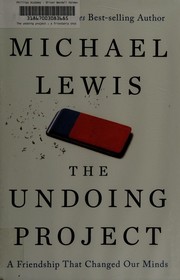
The Undoing Project
The Undoing ProjectMichael Lewis
Influence: The Psychology of Persuasion
Influence: The Psychology of PersuasionRobert B. Cialdini
Poor Charlie's Almanack
Poor Charlie's AlmanackCharlie Munger
The Art of Thinking Clearly
The Art of Thinking ClearlyRolf Dobelli