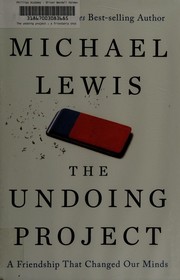
The Undoing Project
Michael Lewis's account of the Kahneman-Tversky collaboration works as intellectual biography and as a second path through the research for readers who find academic writing slow. The friendship and its eventual fracture clarifies how two very different minds produced work that neither could have done alone.
Summary
Lewis tells the story of the collaboration between Daniel Kahneman and Amos Tversky, from their meeting at Hebrew University in the late 1960s through the work that produced heuristics and biases and prospect theory, to the deterioration of the relationship and Tversky's death in 1996. The book is biography rather than exposition, though it explains the main findings along the way.
Lewis frames it around the question of how two psychologists produced work that reshaped economics, medicine and public policy. He covers their opposite temperaments, Kahneman anxious and self-doubting, Tversky confident and combative, and the way they worked, sitting in a room together and writing sentence by sentence so that neither could say which ideas were whose.
The scientific content covers representativeness, availability, anchoring, the failure of intuitive statistics among trained researchers, and prospect theory's account of value as gains and losses from a reference point. Lewis also covers the Israeli military context, including Kahneman's work on officer selection, which produced his early recognition that confident evaluations could be worthless. The book started because Lewis realised that Moneyball had described a phenomenon that Kahneman and Tversky had explained years earlier. The final sections cover the estrangement, driven partly by the asymmetric credit Tversky received, and Kahneman's difficulty completing the reconciliation before Tversky's death.
The treatment of the psychology is secondhand and much less precise than Kahneman's own book. Lewis writes to a narrative shape, and the personalities carry the book more than the research does. Some psychologists have objected that he overstates the pair's isolation and originality. Read it for the story of the collaboration, and read Thinking, Fast and Slow for the findings.
Key takeaways 8
- Kahneman and Tversky showed that trained statisticians apply intuitive judgment rather than statistical reasoning when the problem is presented informally.
- People judge probability by how closely a case resembles a category, ignoring the base rate of that category entirely.
- Prospect theory establishes that people evaluate outcomes as gains and losses from a reference point rather than as final states.
- Kahneman's work on Israeli officer selection showed that confident assessments by trained evaluators had essentially no predictive validity.
- The pair worked by writing together in a room rather than dividing tasks, which made individual attribution impossible and eventually damaged the relationship.
- Expert clinical judgment in medicine and other fields is regularly outperformed by simple statistical rules built from the same inputs.
- The undoing of events, meaning the ease with which a person can imagine an alternative outcome, determines the intensity of regret rather than the outcome itself.
- Their findings were resisted longest by the professions whose expertise the findings challenged.
Who should read it
Readers who want the human history behind behavioural economics, best used as background to rather than a substitute for the primary work.
About Michael Lewis
Financial journalist and author; former Salomon Brothers bond salesman
Liar's Poker, The Big Short and Flash Boys are the primary narrative sources later writers build on for Wall Street of the 1980s, the subprime crisis and high-frequency trading.
Where it sits in the reference 5
Who recommended it 9 · 3 direct
Similar books 6
Chosen by shared topics, the entries that hold them, and the people who recommended both.