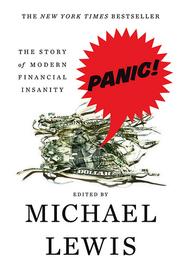
Panic: The Story of Modern Financial Insanity
Anthology edited by Lewis
Summary
Lewis edited this anthology of contemporaneous journalism and commentary covering four episodes: the 1987 crash, the Russian default and Long-Term Capital Management collapse in 1998, the dot-com bubble and bust, and the subprime and credit crisis then unfolding in 2008. He supplies section introductions and a small amount of his own writing.
The value of the format is that the pieces were written before anyone knew how each episode would end. Reading commentary from October 1987 or from March 2000 shows what informed people actually believed at the time, including the confident explanations that turned out to be wrong and the warnings that were dismissed. Lewis chose pieces that display both, and the effect is a demonstration that the clarity of hindsight is manufactured after the fact.
The collection includes work by Roger Lowenstein, Dave Barry, Bethany McLean, John Cassidy and others, along with technical explanations and satire. Lewis's introductions make the argument that the four episodes share a structure: a new financial instrument or asset class, a story about why the old rules no longer apply, a period of self-reinforcing price increases, and a sudden discovery that nobody understood the risk. For investors the use is calibration. It shows how badly the professional consensus reads a situation in real time. The book is a compilation and it has no sustained analysis, the 2008 section was assembled while the crisis was still running and is therefore incomplete, and readers who have already read Lewis's own books will find some of the material familiar.
Key takeaways 7
- Contemporaneous commentary on financial crises is consistently wrong in ways that hindsight erases, and reading it is the best available calibration on one's own real-time judgement.
- Each of the four episodes followed the same sequence: a new instrument, an argument that old rules no longer applied, self-reinforcing prices, and a discovery that the risk was not understood.
- Portfolio insurance in 1987 was a hedging technique that produced the selling cascade it was designed to protect against.
- Long-Term Capital Management's failure came from position size relative to market liquidity, not from the models being wrong about relative value.
- Warnings before each crisis were public and specific, and were dismissed because the people making them had been early during the preceding profitable period.
- Financial journalism during a bubble mostly explains and legitimises the prevailing story rather than testing it.
- The instrument at the centre of each episode was in every case new enough that no participant had observed it through a full cycle.
Who should read it
Investors who want to see how professional opinion actually read four crises in real time, as a check on their own hindsight.
About Michael Lewis
Financial journalist and author; former Salomon Brothers bond salesman
Liar's Poker, The Big Short and Flash Boys are the primary narrative sources later writers build on for Wall Street of the 1980s, the subprime crisis and high-frequency trading.
Where it sits in the reference 2
Who recommended it 2 · 1 direct
Similar books 6
Chosen by shared topics, the entries that hold them, and the people who recommended both.





