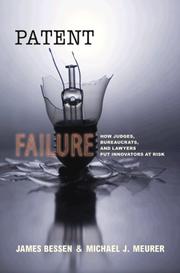
Patent Failure
Evidence that patents work poorly as property; the IP-as-asset skeptic case.
Summary
James Bessen and Michael Meurer test whether the patent system works as a property system, and conclude that outside chemicals and pharmaceuticals it does not. Their standard is economic: a property system works when the value it confers on owners exceeds the costs it imposes, and when boundaries are clear enough that people can avoid infringing inadvertently.
The empirical work uses stock market event studies around patent litigation to estimate the costs litigation imposes on defendants, and compares that with estimates of the profits patents generate for their owners. For American public firms outside chemicals and pharmaceuticals, they find that litigation costs exceeded patent profits from the late 1990s onward. The disparity is largest in software and business methods, where the number of patents is large, the boundaries are vague, and searching for relevant patents before developing a product is impractical.
Their diagnostic emphasis is on notice: a property system requires that a person can determine in advance what they may not do. Land has surveys and registries; patents have claim language whose scope is determined only by litigation, often years later. Chemical and pharmaceutical patents work better because a molecule can be specified precisely. Their reform proposals concern claim clarity, examination quality, and reducing the cost of challenging bad patents. The book is quantitative and its estimates have been disputed on method, particularly the event study approach. The notice argument has been widely accepted and shaped subsequent policy debate.
Key takeaways 7
- For American public firms outside chemicals and pharmaceuticals, patent litigation costs exceeded the profits patents produced.
- A property system requires clear notice, meaning a person can determine in advance what they must not do, and patent claims do not supply it.
- Software patents fail the notice requirement because claim language is abstract and searching for relevant patents before development is impractical.
- Chemical and pharmaceutical patents function better because a molecule can be specified precisely enough to define a boundary.
- Patent scope is determined by litigation years after the patent issues, which makes ex ante avoidance impossible.
- The growth in patent numbers reflects defensive accumulation rather than an increase in invention.
- Bessen and Meurer argue that a patent system failing the notice test taxes innovation rather than encouraging it.
Who should read it
Technology founders and investors who want empirical evidence on whether patents create or destroy value in their sector.
Where it sits in the reference 2
Similar books 6
Chosen by shared topics, the entries that hold them, and the people who recommended both.