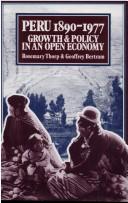
Peru 1890-1977: Growth and Policy in an Open Economy
The classic export-led growth study; why commodity booms did not compound.
Summary
Rosemary Thorp and Geoffrey Bertram wrote this study of the Peruvian economy across nearly a century, and it became a standard work in Latin American economic history. Their subject is why an economy with successive export booms failed to convert them into sustained development.
Their analytical concept is returned value: the share of export earnings that remains in the domestic economy as wages, taxes, locally purchased inputs and reinvested profit, rather than accruing abroad to foreign owners or being spent on imports. They trace this across Peru's export cycles in guano, sugar, cotton, oil, copper and fishmeal, and show that the share retained domestically varied enormously by commodity and by ownership structure. Locally owned export sectors generated linkages that foreign-owned enclaves did not, and the political economy determined which arrangements prevailed.
The book combines detailed quantitative reconstruction with political analysis of the Peruvian elite's choices. Its argument was influential in the structuralist and dependency debates, though the authors are more empirical than most participants in those arguments. It ends in 1977, before the debt crisis, the hyperinflation of the 1980s, the Fujimori period and the mining boom of the 2000s. The returned value framework remains directly applicable to any resource economy and to the current arguments about local content requirements.
Key takeaways 7
- The share of export earnings retained in the domestic economy, rather than the size of the export boom, determines its development effect.
- Locally owned export sectors generate domestic linkages that foreign-owned enclaves do not.
- Peru's successive export booms produced growth without cumulative development because retained value stayed low.
- Ownership structure in the export sector is a political outcome rather than a technical necessity of the industry.
- Elite consumption of imported goods dissipated export earnings that could have funded domestic investment.
- The authors argue that policy could have raised returned value substantially and that the Peruvian elite had no interest in doing so.
- Export diversification across commodities did not help, because each new boom repeated the same ownership and spending pattern.
Who should read it
Analysts of resource economies who want the returned-value framework and a century-long test of it in one country.
Where it sits in the reference 2
Similar books 6
Chosen by shared topics, the entries that hold them, and the people who recommended both.