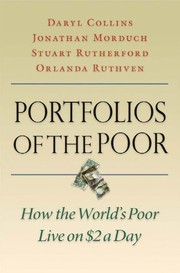
Portfolios of the Poor
Financial diaries showing how poor Bangladeshi households actually manage money.
Summary
Collins, Morduch, Rutherford and Ruthven ran financial diaries with roughly 250 poor households in Bangladesh, India and South Africa, visiting each household every two weeks for a year and recording every financial transaction. The book reports what the diaries showed.
The central finding overturns the assumption that poor households have simple financial lives. The households in the study used a wide range of instruments simultaneously: savings clubs, moneylenders, shopkeeper credit, loans to and from relatives and neighbours, savings held with a neighbour for safekeeping, microfinance loans, insurance-like burial societies, and money kept at home. The average household used around ten distinct instruments over the year and moved sums through them far larger than their annual income.
The explanation is that the defining feature of poverty is not the low level of income but its irregularity and unpredictability. A household with an uncertain daily income must manage cash flow constantly, and the instruments exist to convert irregular income into the lump sums that school fees, funerals, illness and business inputs require. The authors call this the triple whammy: low incomes, irregular incomes, and a lack of financial instruments suited to managing them.
The policy implication is that the poor need reliable savings and payment services at least as much as credit, which the microfinance movement had underweighted. The evidence is a small non-representative sample, which the authors acknowledge, and the diaries method captures behaviour in detail at the cost of generalisability. It reoriented the field.
Key takeaways 7
- The defining problem of poverty is the irregularity and unpredictability of income rather than its level alone.
- Poor households manage complex financial portfolios, using around ten distinct instruments over a year and moving sums far exceeding their annual income.
- The poor need reliable savings and payment services at least as much as credit, which the microfinance movement systematically underweighted.
- Informal instruments including savings clubs, shopkeeper credit and reciprocal lending exist because they solve problems that formal products do not address.
- Interest rates on small short-duration informal loans appear extortionate when annualised and are frequently reasonable in the terms the borrower uses.
- Converting irregular small income flows into usable lump sums is the central financial task poor households face.
- Reliability and convenience matter more than price to poor households choosing a financial instrument, because the cost of a service failing is severe.
Who should read it
Founders and investors in financial inclusion who need to understand what poor households actually do with money before designing a product for them.
Where it sits in the reference 3
Who recommended it 1
Similar books 6
Chosen by shared topics, the entries that hold them, and the people who recommended both.