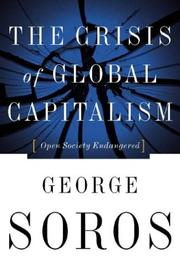
The Crisis of Global Capitalism
Summary
Soros wrote this immediately after the 1997 Asian and 1998 Russian crises, arguing that global financial markets are inherently unstable and that the international system had no adequate mechanism for managing them.
The theoretical foundation is his concept of reflexivity, which he had set out in The Alchemy of Finance. Participants in a market form views about it, act on those views, and their actions change the situation they were assessing, so there is a two-way connection between thinking and reality rather than the one-way relationship assumed by equilibrium theory. Prices therefore do not converge to a value determined independently of them, and self-reinforcing processes can run a long way before reversing.
His policy argument is that the international financial architecture was asymmetric: capital flowed to emerging economies during booms and withdrew during crises, the IMF's interventions protected creditors while imposing adjustment on debtors, and there was no lender of last resort or deposit insurance at the international level. He proposed international credit insurance and other mechanisms.
The wider political argument attacks what he calls market fundamentalism, the belief that markets tend toward equilibrium and that social outcomes should be left to them, and argues it is as dangerous to open society as the ideologies it replaced.
The book was written quickly and shows it. The reflexivity concept is presented more philosophically than usefully, and economists have generally found it too loose to be operational. Its forecast of imminent global collapse did not occur in 1998, though the mechanisms Soros identified operated in 2008.
Key takeaways 7
- Market participants act on views that change the situation they were assessing, which means prices and fundamentals influence each other in both directions.
- Self-reinforcing processes between perception and reality can run far from any equilibrium before reversing, and the reversal is what produces crises.
- Financial markets do not tend toward equilibrium, which makes the assumption underlying most policy and regulation incorrect.
- Capital flows to emerging economies during booms and withdraws during crises, which amplifies rather than smooths the cycle.
- The international financial system lacked any lender of last resort or deposit insurance, so crises had no mechanism for containment.
- IMF interventions protected creditors while imposing adjustment costs on debtor populations, which is a distributional choice presented as a technical necessity.
- Belief that markets should determine all social outcomes is an ideology rather than a finding, and Soros treats it as a threat to open society.
Who should read it
Investors interested in reflexivity as a market theory and in a contemporaneous critique of the international financial architecture after the 1997 crises.
About George Soros
Founder, Soros Fund Management and the Quantum Fund; founder, Open Society Foundations
The Alchemy of Finance introduced reflexivity, a primary-source framework macro traders and academics still build on.
Where it sits in the reference 4
Similar books 6
Chosen by shared topics, the entries that hold them, and the people who recommended both.