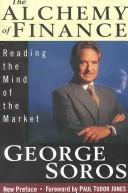
The Alchemy of Finance
Introduces reflexivity; includes the 1985-86 real-time experiment.
Summary
Soros presents his theory of reflexivity and then documents a real-time experiment in which he ran his fund while recording his reasoning, from August 1985 through November 1986, so that readers can compare his stated thinking against subsequent outcomes.
Reflexivity holds that in markets there is a two-way connection between participants' thinking and the situation they are thinking about. Participants' expectations influence prices, prices influence the fundamentals through financing conditions, credit availability and corporate behaviour, and the changed fundamentals then influence expectations. Soros argues that this makes equilibrium theory inapplicable, since the underlying reality is not independent of beliefs about it.
He applies the framework to boom and bust sequences with a specified structure: an initial trend, a period during which the trend and the prevailing bias reinforce each other, a moment of truth when the gap between expectation and reality becomes apparent, a twilight period, and a reversal. He works through the conglomerate boom of the 1960s, the real estate investment trust cycle, the international lending boom that produced the 1982 debt crisis, and the 1980s currency system.
The real-time experiment is the most interesting section methodologically, because it records positions and reasoning before outcomes, including where he was wrong. The book is genuinely difficult. Soros writes abstractly, the philosophical sections are dense, and the market conditions of 1985 and 1986 require background. Economists have largely ignored reflexivity, arguing it restates known feedback effects without producing testable predictions. Soros himself has said the book is hard to follow. Its value is the description of how a successful macro trader thinks about the relationship between belief and fundamentals.
Key takeaways 8
- Market prices and underlying fundamentals influence each other in both directions, which means the fundamentals are not independent of what participants believe about them.
- Equilibrium models fail in financial markets because they assume an independent reality that participants' beliefs do not alter.
- Boom and bust sequences follow a specific structure in which a prevailing bias and an underlying trend reinforce each other until the gap becomes untenable.
- A trend that requires continuously increasing credit to sustain itself carries the mechanism of its own reversal.
- Being wrong is not the problem, and Soros argues that recognising error quickly and reversing is the operative skill.
- Position sizing should increase when a hypothesis is confirmed by market behaviour rather than being fixed at entry.
- Recording predictions before outcomes are known is the only way to evaluate a decision process, which is why Soros structured the book as a real-time experiment.
- Financial markets are always wrong in the sense that they embody a prevailing bias, and the profitable question is which direction the bias runs.
Who should read it
Macro investors willing to work through difficult prose for a first-person account of how belief and fundamentals interact in a trading process.
About George Soros
Founder, Soros Fund Management and the Quantum Fund; founder, Open Society Foundations
The Alchemy of Finance introduced reflexivity, a primary-source framework macro traders and academics still build on.
Where it sits in the reference 6
Who recommended it 6 · 4 direct
Similar books 6
Chosen by shared topics, the entries that hold them, and the people who recommended both.