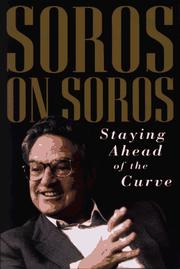
Soros on Soros: Staying Ahead of the Curve
Open Library lists the short title "Soros on Soros".
Summary
This book consists of extended interviews with George Soros conducted by Byron Wien and Krisztina Koenen, covering his life, his investment philosophy and his political views. It was published in 1995, after the 1992 sterling trade had made him publicly known.
The investment sections state reflexivity more accessibly than The Alchemy of Finance does. Soros argues that market participants act on views that are necessarily imperfect, that their actions change the fundamentals they are assessing, and that this two-way connection means markets do not tend toward equilibrium. He describes how he uses this in practice: forming a hypothesis about a prevailing bias and the trend it is affecting, taking a position, and treating the market's behaviour as a test of the hypothesis rather than as noise. He describes his practice of looking for the flaw in his own thesis, his use of physical symptoms including back pain as a signal that something in the portfolio is wrong, and his willingness to reverse a position entirely.
The sterling trade is discussed directly: the argument that the exchange rate mechanism required Britain to hold a rate incompatible with its domestic conditions, that the Bundesbank would not cut rates to help, and that the position was therefore asymmetric because the downside was limited by the band.
The biographical material covers Budapest under Nazi occupation, the London years and the philosophical influence of Karl Popper, which is the source of the fallibility argument.
The interview form means the ideas are stated without development, and Soros himself acknowledges that reflexivity has not been formalised into anything testable. The book predates his later foundations work, the 1997 and 1998 losses and the fund's transition to a family office.
Key takeaways 7
- Market participants act on views that are necessarily imperfect, and their actions change the fundamentals those views concern.
- A market trend and a prevailing misconception together create the conditions for a boom and bust sequence.
- Soros treats a position as a test of a hypothesis, so market behaviour that contradicts the thesis is information rather than noise.
- Looking actively for the flaw in one's own thesis is the practical discipline he claims separates him from other managers.
- The 1992 sterling position was attractive because the exchange rate band limited the downside while the upside was large.
- A fixed exchange rate becomes indefensible when the domestic conditions it implies are politically unacceptable.
- Being willing to reverse a position entirely, rather than reducing it, follows from treating positions as hypotheses.
Who should read it
Investors who want Soros's framework in accessible interview form rather than in the more difficult version he wrote himself.
About George Soros
Founder, Soros Fund Management and the Quantum Fund; founder, Open Society Foundations
The Alchemy of Finance introduced reflexivity, a primary-source framework macro traders and academics still build on.
Where it sits in the reference 3
Similar books 6
Chosen by shared topics, the entries that hold them, and the people who recommended both.