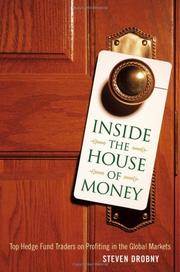
Inside the House of Money
Global macro managers on how they build trades.
Summary
Drobny, who worked in institutional sales covering macro funds, conducted interviews with global macro traders and hedge fund managers about how they actually work. The subjects include managers running discretionary macro strategies, currency traders, commodity specialists and emerging market investors, several of whom are identified and several anonymised.
The interviews are organised around process rather than around views. Drobny asks how each manager generates ideas, how they express a view across instruments, how they size and how they cut. The recurring themes include the preference for asymmetric expressions through options rather than outright directional positions, the use of relative value trades to isolate the specific view while removing unwanted exposures, the practice of taking a small position first and adding as the thesis confirms, and the consistent emphasis that risk management rather than idea generation separates the survivors.
Several subjects discuss specific episodes in detail, including the 1997 and 1998 Asian and Russian crises, the European exchange rate mechanism break of 1992, and the carry trades that periodically unwound.
The interview format has the usual limitations. Subjects are chosen because they survived, they describe their process in retrospect, and there is no way to verify what they claim about past positions. The book also captures a specific period: it was published in 2006, before the 2008 crisis, before the era of central bank suppression of volatility that made discretionary macro much harder, and before the substantial contraction of the strategy's assets. Drobny published a follow-up, The Invisible Hands, after the crisis. Read it for the variety of approaches within one strategy rather than for a method.
Key takeaways 7
- Macro managers express views through the instrument with the best asymmetry rather than through the most direct one.
- Relative value structures isolate the specific view and remove the exposures the manager does not intend to take.
- Taking a small initial position and adding as the thesis confirms is standard practice rather than a sign of low conviction.
- Risk management rather than idea generation distinguishes managers who survive from those who do not.
- Currency and rate positions in emerging markets carry liquidity risk that only appears when the position needs to be exited.
- Carry trades accumulate slowly and unwind violently, which makes their return distribution unsuitable for volatility-based risk measures.
- Managers interviewed after the fact supply reconstructed accounts of their reasoning that cannot be verified.
Who should read it
Investors interested in discretionary macro who want to see how a range of managers generate, express and size views.
Where it sits in the reference 3
Similar books 6
Chosen by shared topics, the entries that hold them, and the people who recommended both.