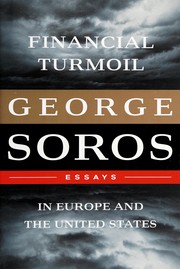
Financial Turmoil in Europe and the United States
Summary
This volume collects essays, lectures and articles Soros wrote between 2008 and 2012, covering the financial crisis and the eurozone crisis as they unfolded.
The theoretical material restates reflexivity: participants act on fallible interpretations, their actions change the fundamentals being interpreted, and the resulting feedback means markets do not tend toward equilibrium. He connects this to his superbubble thesis, that the crisis marked the end of a credit expansion running since the early 1980s rather than an ordinary cycle.
The eurozone material is the more substantial part and Soros was among the earlier commentators to identify what became the consensus diagnosis. He argued that the euro was constructed with a central bank but no common treasury, that member state government bonds had been treated as risk-free when they carried genuine default risk in a currency the issuer could not print, and that once that was recognised the sovereign and banking systems became mutually dependent: banks held their own government's bonds, so sovereign stress damaged banks, and bank rescues damaged sovereigns. He argued that the crisis was being treated as a fiscal problem when it was a banking and balance of payments problem, that austerity in a contracting economy raises the debt ratio, and that Germany's position as the surplus country made it the party whose policy change was required.
His proposals included common eurobonds, a European deposit insurance scheme, and a more active central bank.
The collection is fragmentary by nature, with repetition across pieces and material that has been overtaken. The eurozone diagnosis was substantially correct and partly acted on subsequently. Soros's specific predictions about timing and about the union's survival were not.
Key takeaways 7
- The euro was constructed with a central bank but no common treasury, which left no authority able to stand behind member state debt.
- Member state government bonds were treated as risk-free despite being issued in a currency the government could not print.
- Banks holding their own government's bonds made sovereign and banking systems mutually dependent, so each crisis fed the other.
- The eurozone crisis was a banking and balance of payments problem treated as a fiscal problem, which produced the wrong remedies.
- Austerity applied to a contracting economy raises the debt ratio by shrinking the denominator faster than the numerator.
- The surplus country in a monetary union is the party whose policy change is required, because deficit countries cannot adjust alone.
- Common issuance and shared deposit insurance were proposed years before elements of both were eventually adopted.
Who should read it
Investors who want contemporaneous analysis of the eurozone crisis from an observer who identified the structural problem early.
About George Soros
Founder, Soros Fund Management and the Quantum Fund; founder, Open Society Foundations
The Alchemy of Finance introduced reflexivity, a primary-source framework macro traders and academics still build on.
Where it sits in the reference 2
Similar books 6
Chosen by shared topics, the entries that hold them, and the people who recommended both.