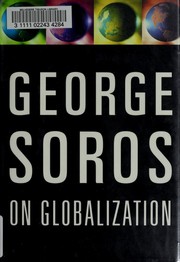
George Soros on Globalization
Summary
Soros wrote this short book arguing that global markets have developed far ahead of the institutions required to govern them, and proposing what should be built.
His diagnosis is an asymmetry. Capital moves freely across borders while labour does not, and while the institutions that provide public goods, social protection and regulation remain national. Capital therefore escapes taxation and regulation by moving, which constrains what states can do, while the costs of financial instability fall on national populations. He argues that this asymmetry rather than trade or markets themselves is what produces the political reaction against globalisation.
His criticism of the international institutions is specific. The International Monetary Fund lends to governments and imposes conditions, which means the costs of a crisis fall on populations while the creditors who lent recklessly are repaid, and this creates moral hazard among lenders rather than among borrowers. The World Trade Organization has strong enforcement for trade rules and none for labour or environmental standards, which is why trade rules advance and the others do not. The World Bank and the aid system channel money through governments, which are frequently the problem.
His proposals include using Special Drawing Rights as a mechanism for funding public goods in poor countries, with rich countries donating their allocations; strengthening the institutions that provide public goods rather than only those that liberalise markets; and reforming the international financial architecture to make creditors bear losses.
The book is short and written for a general audience. Soros's proposals have largely not been adopted, though the Special Drawing Rights allocation of 2021 during the pandemic used a mechanism resembling what he proposed. His diagnosis of the institutional asymmetry has become widely shared.
Key takeaways 7
- Capital moves freely across borders while labour, taxation, regulation and social protection remain national.
- That asymmetry rather than trade itself is what produces the political reaction against globalisation.
- International Monetary Fund lending places crisis costs on populations while repaying creditors who lent recklessly.
- Repaying creditors in full creates moral hazard among lenders rather than among the borrowing countries.
- Trade rules have strong enforcement while labour and environmental standards have none, which is why only trade rules advance.
- Aid channelled through governments funds the institutions that are frequently the obstacle to development.
- Special Drawing Rights could fund international public goods if rich countries donated their allocations.
Who should read it
Readers who want a concise statement of the institutional asymmetry argument about globalisation and a set of specific reform proposals.
About George Soros
Founder, Soros Fund Management and the Quantum Fund; founder, Open Society Foundations
The Alchemy of Finance introduced reflexivity, a primary-source framework macro traders and academics still build on.
Where it sits in the reference 2
Similar books 6
Chosen by shared topics, the entries that hold them, and the people who recommended both.