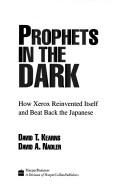
Prophets in the dark
Insider account by Xerox's CEO of the quality-driven turnaround.
Summary
David Kearns was chief executive of Xerox from 1982 to 1990 and wrote this with David Nadler about the company's response to Japanese competition in copiers. Xerox had held a near-monopoly protected by patents, lost most of its share to Canon, Ricoh and others during the 1970s and early 1980s, and then recovered a significant part of it.
The operational content concerns what Kearns did. Competitive benchmarking, which Xerox largely invented as a formal practice, established that Japanese manufacturers were selling machines for less than Xerox's manufacturing cost, with fewer defects and shorter development cycles. That finding produced the Leadership Through Quality programme, which trained the entire workforce in a common problem-solving method, restructured supplier relationships toward fewer suppliers with quality certification, and changed product development toward cross-functional teams. Kearns describes the 10-90 Series development as the test case.
The book is a chief executive's own account, published two years after he left, and it presents the recovery as more complete than it proved. Xerox's subsequent decades included the failure to commercialise the work done at its Palo Alto Research Center, an accounting scandal in 2000, and a near-bankruptcy. Kearns also gives limited attention to the strategic error that preceded everything, which was the diversification into financial services through Crum and Forster. The benchmarking and quality material is the durable content and it influenced a generation of manufacturers.
Key takeaways 7
- Competitive benchmarking established that Japanese competitors sold copiers below Xerox's manufacturing cost, which no internal analysis had revealed.
- A company cannot improve against a standard it has not measured, and Xerox's standard had been its own history.
- Quality programmes fail unless the entire workforce is trained in a single shared problem-solving method.
- Reducing the supplier base and certifying quality at the supplier removes inspection cost and defect rates simultaneously.
- Cross-functional product development teams shortened Xerox's development cycles enough to matter competitively.
- Kearns argues that senior management must be trained first and visibly, because a quality programme delegated downward is not believed.
- Patent protection allowed Xerox to develop cost structures and habits that could not survive the patents expiring.
Who should read it
Operators facing a step change in competitive cost position who want a first-hand account of a large-company quality and benchmarking response.
Where it sits in the reference 2
Similar books 6
Chosen by shared topics, the entries that hold them, and the people who recommended both.