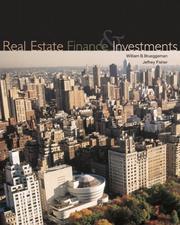
Real Estate Finance and Investments
The standard university text on property underwriting.
Summary
William Brueggeman and Jeffrey Fisher wrote the standard American textbook on real estate finance, used in university courses and by practitioners, and revised across many editions since the 1970s.
The coverage moves from legal foundations through financing instruments to investment analysis. Early chapters cover interests in real property, mortgage instruments and their terms, the mathematics of loan payments and yields, fixed and adjustable rate structures, and residential financing including underwriting and default. The investment chapters cover income property analysis, the construction of pro forma cash flow projections, leverage and its effect on equity returns, tax treatment including depreciation and its recapture, valuation by capitalisation and by discounted cash flow, and the analysis of lease structures.
Later sections cover development and construction financing, joint venture and partnership structures, real estate investment trusts, commercial mortgage-backed securities and the secondary mortgage market, and portfolio considerations for institutional investors. The book's method is worked numerical examples throughout, and its strength is completeness rather than argument. Readers should use a recent edition, since the tax rules, the mortgage market structure and the securitisation material have all changed substantially, particularly after 2008.
Key takeaways 7
- Leverage magnifies equity returns in both directions, and the break-even point is where the loan constant equals the property's unlevered return.
- Property value under the income approach is determined by the capitalisation rate applied to net operating income, so cap rate movement dominates most valuations.
- Depreciation deductions and their recapture on sale determine after-tax returns, which makes tax structure inseparable from investment analysis.
- Lease terms including escalation clauses, expense recovery and tenant improvement allowances determine the actual cash flow behind a headline rent.
- Construction lending carries completion risk that permanent lending does not, which is why the two are financed separately.
- Mortgage default is a decision about the value of the borrower's option to walk away, not merely an inability to pay.
- Securitisation transfers mortgage credit risk to investors whose analysis depends on pool statistics rather than on individual underwriting.
Who should read it
Anyone learning commercial or residential real estate finance who needs a complete technical reference with worked examples, using a current edition.
Where it sits in the reference 2
Similar books 6
Chosen by shared topics, the entries that hold them, and the people who recommended both.