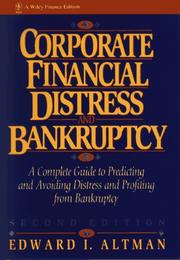
Corporate Financial Distress and Bankruptcy
The academic standard; source of the Z-score.
Summary
Altman, who created the Z-score bankruptcy prediction model in 1968, and Hotchkiss produced the standard reference on corporate distress. It covers prediction models, the legal process of bankruptcy, the market for distressed securities, recovery rates and the empirical evidence on outcomes.
The prediction material is the book's foundation. Altman's Z-score combines five financial ratios into a single discriminant score that separates firms likely to fail from those likely to survive, and the book covers its construction, its subsequent variants for private and non-manufacturing firms, its performance over decades, and competing models including hazard models and structural models based on option pricing.
The legal and empirical material covers the Chapter 11 process, the frequency and consequences of Chapter 22, meaning a second bankruptcy after emerging from a first, the direct and indirect costs of distress, the determinants of recovery rates by seniority and by industry, and the performance of distressed securities as an investment class. Altman's work on recovery rates being negatively correlated with default rates is important for credit modelling, since it means losses are worst exactly when defaults are most numerous.
The book is a reference work with extensive empirical tables. It has been revised across editions and readers should use a recent one, since bankruptcy practice, recovery data and the distressed market have all changed substantially. The prediction models remain in wide use and their limitations, particularly poor performance on financial firms and on companies with substantial intangible assets, are stated by the authors.
Key takeaways 7
- A small number of financial ratios combined in a discriminant model separate firms likely to fail from those likely to survive with useful accuracy.
- Recovery rates on defaulted debt are negatively correlated with default rates, which means credit losses are worst exactly when defaults are most numerous.
- A substantial share of firms emerging from Chapter 11 file again, which indicates many reorganisations resolve the balance sheet without addressing the business.
- Indirect costs of financial distress, including lost customers, supplier terms and departing staff, exceed the direct legal and advisory costs.
- Recovery rates vary systematically by seniority, by collateral and by industry, and industry asset specificity is a major determinant.
- Bankruptcy prediction models perform poorly on financial firms and on companies whose value is in intangible assets, which the ratios do not capture.
- Distressed securities have produced attractive returns as an asset class, and the returns are concentrated in periods immediately following default waves.
Who should read it
Credit analysts and distressed investors who need the standard reference on failure prediction, recovery rates and bankruptcy outcomes.
About Edward I. Altman
Professor emeritus of finance at NYU Stern who created the Z-score model of bankruptcy prediction.
The Z-score gave credit analysts a published, testable formula for default probability from balance sheet ratios, and it is still the default screen in distressed work. Corporate Financial Distress and Bankruptcy sets out the mechanics of Chapter 11 and restructuring alongside the recovery and default statistics that distressed investors price against.
Where it sits in the reference 4
Similar books 6
Chosen by shared topics, the entries that hold them, and the people who recommended both.