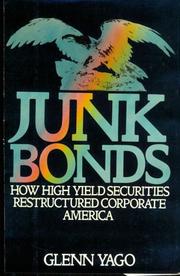
Junk Bonds
The revisionist defence of high yield as a financing innovation.
Summary
Yago, an economist then at the Milken Institute's precursor institutions, wrote an empirical defence of the high yield bond market against the political and regulatory attack it faced after the Drexel collapse. His argument is that the market financed growth companies that could not access investment grade credit, and that the political reaction destroyed a useful institution.
His evidence concerns what high yield issuance actually funded. Yago analyses the use of proceeds across issues and argues that the majority financed capital investment, expansion and refinancing rather than hostile takeovers, which were a small share of volume though they dominated coverage. He documents the employment and investment records of high yield issuers relative to comparable investment grade firms and argues the issuers grew faster and added more employment. He also examines default rates and argues that returns to high yield investors, after defaults, exceeded investment grade returns.
He attributes the market's collapse to regulatory action, specifically the requirement that savings institutions divest high yield holdings, which forced simultaneous selling into a market with no other buyers, rather than to any deterioration in credit quality.
The book is advocacy from an institution funded by the market's principal figure, and readers should weight it accordingly. Subsequent research has confirmed parts of the argument, particularly that takeover financing was a minority of issuance and that forced divestiture worsened the collapse, while the claims about issuer performance rest on comparisons whose selection is disputed.
Key takeaways 7
- The majority of high yield bond issuance financed capital investment, expansion and refinancing rather than hostile takeovers.
- High yield financing gave growth companies without investment grade ratings access to long-term capital that bank lending would not provide.
- Returns to high yield investors after accounting for defaults exceeded returns on investment grade bonds over the period studied.
- Regulatory requirements forcing savings institutions to divest high yield holdings created simultaneous selling into a market with no other buyers.
- The market's collapse was caused by forced regulatory selling rather than by a deterioration in the underlying credit quality of issuers.
- Credit rating categories reflect firm size and asset tangibility as much as default risk, which excluded growing companies regardless of their prospects.
- The political reaction to the leveraged buyout period removed a financing channel that primarily served companies unrelated to takeovers.
Who should read it
Credit investors interested in the empirical defence of high yield financing, read with the author's institutional affiliation in mind.
Where it sits in the reference 4
Similar books 6
Chosen by shared topics, the entries that hold them, and the people who recommended both.